Wood Effect Porcelain Tiles: When They Work, When They Don't, and What to Look For
An honest assessment of wood effect porcelain tiles. Where they outperform real wood, where they fall short, and how to spot a convincing one from a cheap imitation.
Wood effect porcelain has been around for over a decade, but the quality range from cheap to premium is enormous. A bad wood effect tile is one of the most disappointing flooring choices you can make. A good one is genuinely indistinguishable from real wood from across the room and dramatically more practical to live with. The difference between the two is not subtle.
This guide is what I tell clients who ask whether wood effect porcelain is worth it, and what to look for when choosing.
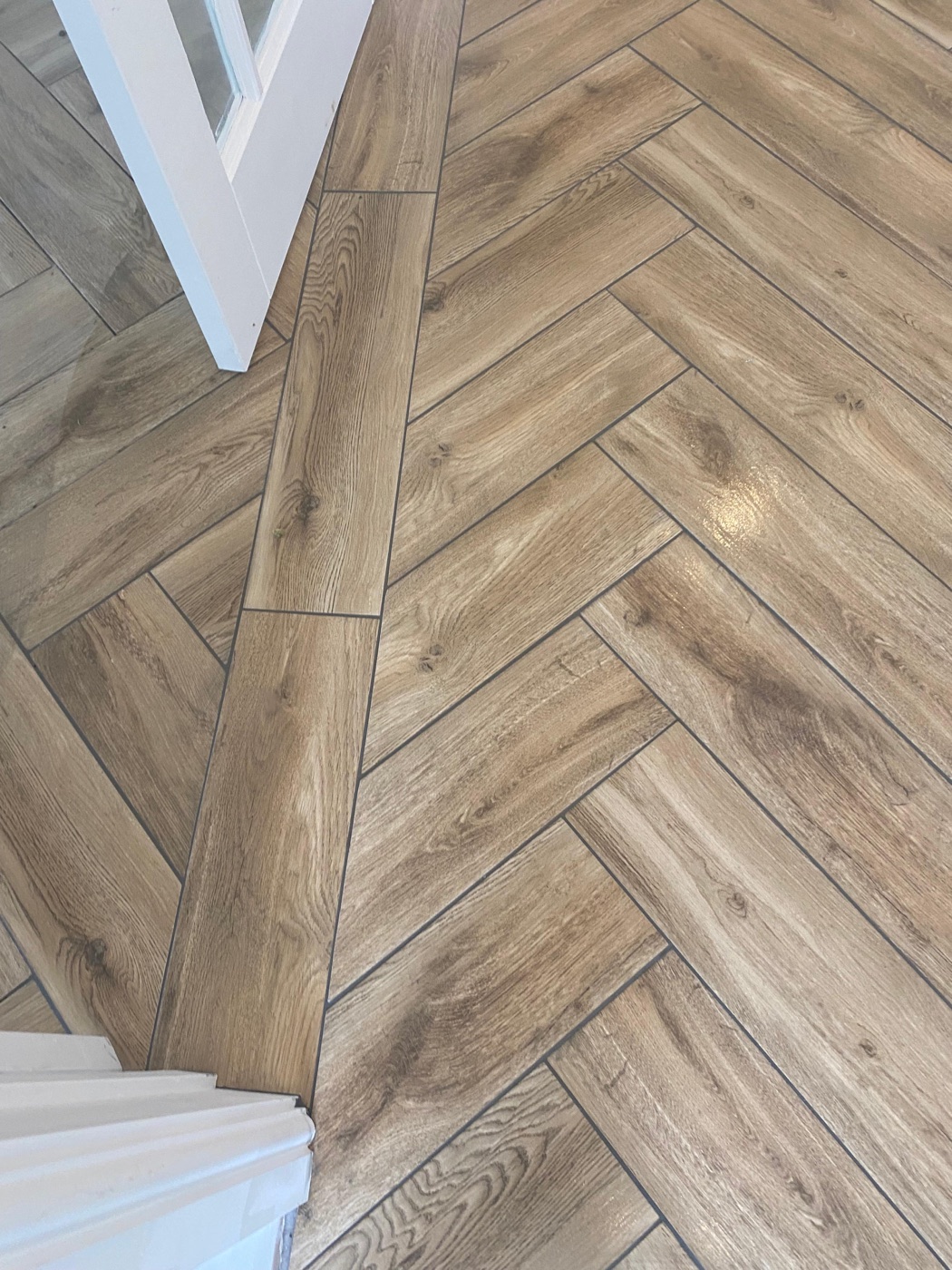 Oak-effect porcelain herringbone hallway, Petts Wood. The herringbone pattern adds character that straight lay planks cannot match. The plank format and matte finish give the appearance of real timber. The porcelain underneath delivers the durability that timber would not in this high-traffic location. Floor tiling service
Where wood effect porcelain wins
There are specific situations where wood effect porcelain is objectively better than real wood, regardless of aesthetic preference.
Bathrooms. Real wood and consistent moisture exposure do not coexist. Even engineered wood floors deteriorate in bathrooms over years, particularly around the bath, basin, and shower. Wood effect porcelain handles a bathroom indefinitely without any of the swelling, warping, or surface damage that wood develops.
Kitchens. Spilled water, dropped pans, dragged appliances, dropped knives. Real wood scratches, dents, and stains. Wood effect porcelain shrugs off all of it. For a working family kitchen, it is the right choice.
Underfloor heating. Real wood and underfloor heating is a difficult pairing. Solid wood is essentially incompatible — the thermal cycling causes movement that no amount of acclimatisation prevents. Engineered wood works to a point but the heat output has to be limited to protect the timber. Wood effect porcelain has no thermal limitations and conducts heat efficiently. See tiling over underfloor heating.
Open plan kitchen-diners. The continuous floor between kitchen and dining area benefits from a single material that handles the full range of activities. Wood effect porcelain is durable enough for the kitchen and warm enough for the dining area. Real wood works in the dining area but not the kitchen, so the floor either compromises one space or splits at the threshold.
Hallways and entrance halls. Mud, grit, and water from outside shoes are the enemy of timber. Wood effect porcelain handles all of it without the wear that develops on real wood in these high-traffic transition zones.
Where real wood is still better
Large drawing rooms and bedrooms. Where moisture is not a concern and the room is rarely subjected to dropped objects, real wood develops a patina over time that porcelain cannot replicate. The slight unevenness, the way it ages, the warmth underfoot — these are properties that even the best wood effect porcelain does not match.
Period properties where authenticity matters. A Victorian terrace with original pine boards, sympathetically restored, is more appropriate than a porcelain replacement. Even if the porcelain looks similar, the historical integrity is different.
Restoration of existing wood floors. If you have a real wood floor in good underlying condition, sanding and refinishing is almost always the better choice than replacing with porcelain.
How to spot a good wood effect tile
The price range for wood effect porcelain is roughly £20 per square metre to £80 per square metre at retail. The difference at the cheap end versus the expensive end is significant, and you can see it.
Number of unique patterns in the range. This is the single most important indicator. Premium wood effect ranges have 20 to 40 unique face patterns. Cheap ranges have 4 to 6. When a cheap tile is laid across a floor, the same patterns appear repeatedly in obvious clusters. The eye picks it up immediately and the floor reads as “tile pretending to be wood” rather than wood. Premium ranges with more variation read as a real timber floor where no two boards are identical.
Ask the supplier for a face pattern count. If they cannot tell you, they are selling a low-end range.
Surface texture. Run your hand over the tile. A convincing wood effect has subtle relief that follows the grain pattern — raised lines where the timber grain would protrude, slight depressions where knots and gaps would be. Cheap wood effect is dead flat, with the wood grain only as a printed image on the surface. The flat ones look painted; the textured ones look real.
Edge profile. Premium plank porcelain has slight micro-bevels on the long edges that mimic the way real timber boards meet. Cheap plank porcelain has hard 90-degree edges. The micro-bevels create a subtle shadow line between planks that reads as authentic.
Tone variation within a single tile. Real wood is not one colour. It has highlights, lowlights, knots, grain density variation. Premium wood effect porcelain reproduces this with several colours blended within each tile. Cheap wood effect uses one or two colours with minimal variation.
Rectified vs non-rectified. Rectified tiles have machine-cut edges that allow a tight 2mm grout joint. Non-rectified have wider tolerances and need 3-4mm joints. Rectified is preferable for wood effect because the tighter joint reads more like real timber.
Format choice
100x600 or 150x600 planks. The classic narrow plank format. Suits most rooms. Gives the appearance of timber boards. The most common format in wood effect porcelain.
200x1200 or 300x1500 planks. Wider, longer planks for a more contemporary feel. Particularly effective in larger rooms where the longer plank length emphasises the floor area. Less obviously “wood look” because real timber boards are rarely this size.
900x150 narrow planks. Slim continental format. Very contemporary. Less flexible than standard plank but striking in the right setting.
Pattern choice
Straight lay in random offset is the standard approach. The pattern emulates the way real wood floors are laid. Random offset means each plank is slightly offset from its neighbours, which prevents obvious vertical lines forming.
Brick bond (50% offset) is slightly more formal but still wood-appropriate. Predictable pattern. Cleaner look.
Herringbone is the showstopper. Wood effect plank in herringbone is one of the most popular floor patterns I install. It transforms a plain wood look into a feature that reads as quality. The labour cost is 30-40% higher than straight lay because of the angled cuts and slower laying. The result justifies the cost.
Chevron uses purpose-cut tiles with mitred ends so the V-points meet seamlessly. More expensive again because it requires specially produced tiles. Less common but exceptional in the right context.
Common mistakes
Choosing cheap wood effect to save money on a kitchen floor. The repetition becomes obvious within a few weeks of living with it. Better to spend more on a smaller area or choose a different material entirely.
Mismatched wall tile styles. Wood effect floor with stone effect walls works. Wood effect floor with very contemporary glossy walls clashes. The flooring sets the room tone and the wall choices need to follow.
Skipping the underlay/decoupling membrane on timber subfloors. Wood effect porcelain on a flexing timber floor without decoupling will crack within a year. The substrate matters as much as the tile choice. See why tiles crack.
Wrong grout colour. Match the grout to the darkest tone in the wood effect, not the lightest. A light grout against dark wood effect creates a grid that breaks the timber illusion.
For advice on wood effect porcelain for your specific room, get in touch for a free site visit. See also: kitchen floor tile guide | herringbone vs straight lay | tiling over underfloor heating
Got a specific question? Call me on 07990 521717 , see the kitchen floor tiling service, or use the contact form — I'm happy to give advice with no obligation.