Tiling a Conservatory or Extension: Substrate Transitions, DPM, and What to Get Right
How to tile a conservatory floor or house extension. Different substrates, damp proof membranes, underfloor heating, and the technical details that prevent failure.
Conservatories and extensions are among the most variable tiling environments in a domestic property. The temperature range is extreme (a south-facing conservatory can reach 40 degrees in summer and drop below freezing in an unheated winter). The substrate is often a basic concrete slab with uncertain damp proofing. And where the extension meets the original house, two different substrates create a movement risk.
None of these are insurmountable. They all need addressing before tiling starts.
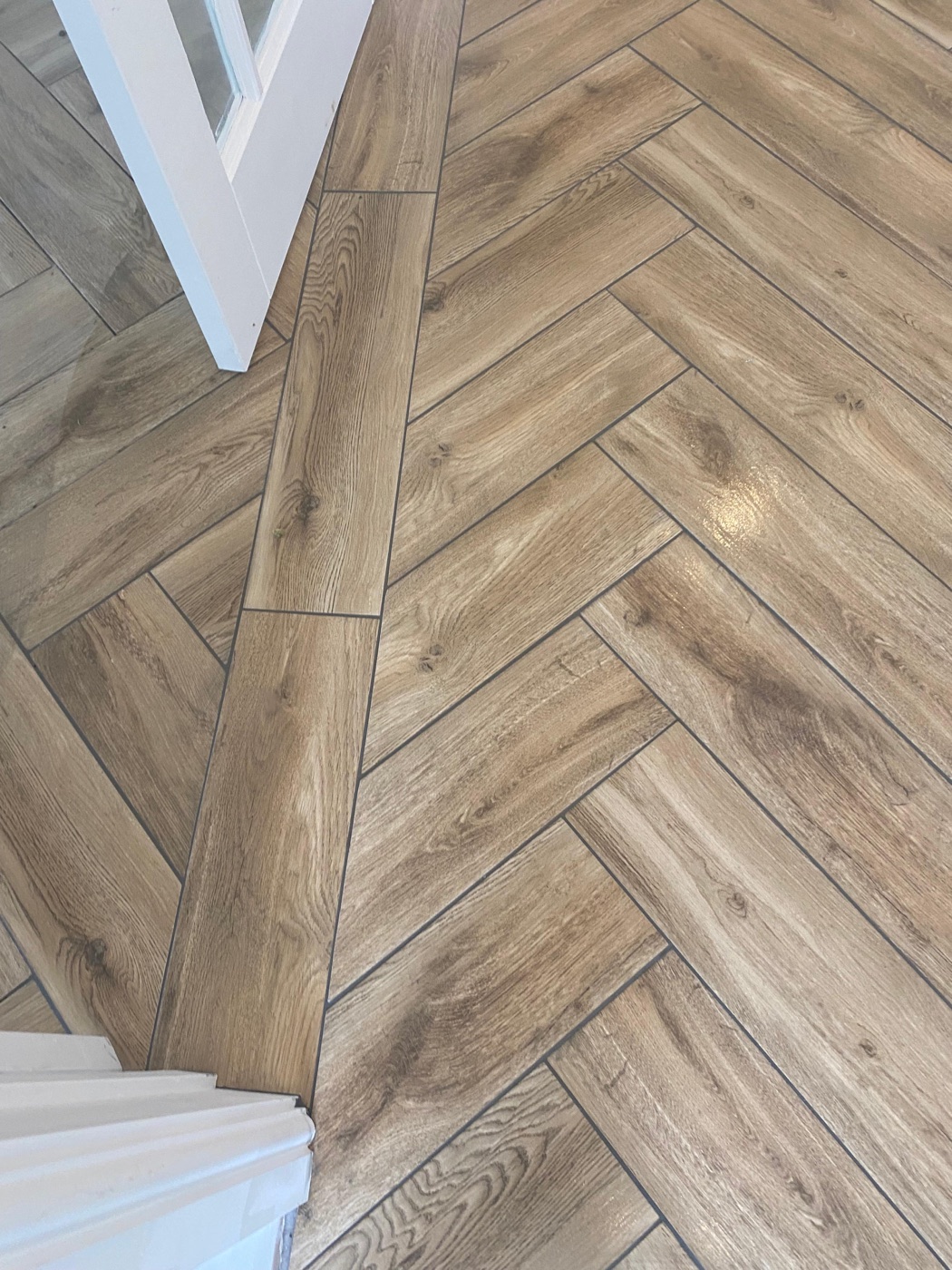 Oak herringbone hallway, Petts Wood. The same technical considerations that apply to hallway tiling — substrate preparation, decoupling on timber, expansion joints — apply to conservatory and extension floors with the additional variables of temperature range and ground moisture. Floor tiling service
Conservatory floors
The temperature challenge
A conservatory is not a controlled indoor environment. Without heating in winter, the air temperature and floor temperature drop to outdoor levels. In summer with direct sun, the glass roof and walls create a greenhouse effect that pushes temperatures well above what any indoor room reaches.
This temperature range means:
Tile choice matters. Frost-proof porcelain (water absorption below 0.1%) is essential if the conservatory is unheated in winter. Standard porcelain (below 0.5%) may survive but is not guaranteed. Ceramic is not suitable.
Adhesive must be flexible. The daily and seasonal temperature cycling causes expansion and contraction in both the slab and the tiles. Flexible adhesive (C2 S1 minimum) absorbs this movement. Rigid adhesive cracks.
Expansion joints are critical. More so than any indoor room. At the perimeter, at every 3-4 metres across the floor, at the threshold between conservatory and house, and around any fixed elements.
The moisture challenge
Conservatory slabs are ground-bearing concrete — they sit directly on the ground. Moisture rises from the earth through the concrete by capillary action. Without a damp proof membrane (DPM), this moisture reaches the tile adhesive and causes:
- Adhesive failure. Moisture undermines the adhesive bond.
- Efflorescence. White salt deposits on the tile surface caused by moisture carrying mineral salts through the concrete and adhesive.
- Mould. In warm, moist conditions, mould can develop beneath the tiles.
The fix: Apply a liquid DPM (like BAL DPM or similar) to the concrete surface before priming and tiling. If the slab was constructed with a DPM built in (check with the builder), a surface application may not be needed — but verify rather than assume.
Common conservatory tile choices
Large format stone effect porcelain (600x600 or 600x900). Clean, contemporary, hides the substrate imperfections that are common in conservatory slabs. Matte finish for safety (conservatory floors get wet from rain blown through open doors).
Wood effect porcelain plank. Warm underfoot look without the moisture sensitivity of real wood. Popular in conservatories used as dining or living spaces.
Natural stone (limestone, sandstone, slate). Authentic and beautiful in the right conservatory. Requires sealing. Only suitable if the conservatory is heated enough to prevent frost damage.
Terracotta effect. Suits period conservatories and orangeries. Genuine terracotta needs sealing; porcelain reproductions do not.
Extension floors
Extensions add to the original house and the tiling challenge is getting the floor to read as continuous between old and new.
The substrate transition
The original house typically has either:
- A suspended timber floor (Victorian, Edwardian, and inter-war properties)
- An old concrete floor (post-war properties)
The extension has a new concrete slab.
These two substrates move independently. The timber section flexes. The concrete sections may settle at different rates (the old one has finished settling, the new one is still curing). A tile that spans the junction without accommodation will crack.
The solution is the same as for open plan kitchens: decoupling membrane across the full floor, movement joint at the substrate transition, flexible adhesive throughout. See open plan kitchen floor tiling for the full approach.
Underfloor heating in extensions
Most modern extensions include underfloor heating. The tiling specification adds:
- UFH-rated adhesive (C2 S1 or S2)
- Commissioning period before tiling
- Additional expansion joints for thermal cycling
See tiling over underfloor heating.
Floor height matching
The extension floor level needs to match the original house floor level at the threshold. If the extension slab is set at a different height, the tile build-up (levelling compound + membrane + adhesive + tile) needs to bring both floors to a consistent finished level.
This is planned during construction, not during tiling. If the slab heights are wrong, the tiler has limited options to correct them.
Orangeries and garden rooms
Modern orangeries and garden rooms sit between conservatories and full extensions in terms of construction. They typically have:
- Solid walls with glazed sections (better insulated than a conservatory)
- A proper roof (not glass)
- Underfloor heating in most cases
- A new concrete slab
The tiling specification is essentially the same as an extension. If the space is heated year-round, standard porcelain is fine. If it is unheated in winter, specify frost-proof.
What I assess on site
For a conservatory or extension tiling quote, I check:
- Substrate type and condition. Concrete quality, flatness, any existing DPM.
- Moisture levels. A moisture meter reading on the slab tells me whether a DPM is needed.
- Connection to the house. Where old meets new, what the substrates are, whether a movement joint is needed.
- Heating provision. Is the space heated? Is there underfloor heating? Has it been commissioned?
- Temperature exposure. South-facing glass conservatories need a different specification from a solid-roofed north-facing extension.
- Drainage falls. For conservatories at ground level, does the floor slope toward doors or drains?
From this assessment I provide a specification that accounts for all the environmental variables. The tile might be the same product you would use in a kitchen, but the adhesive, membrane, and joint specification will be different.
For a free conservatory or extension floor assessment across Bromley and South East London, get in touch.
See also: open plan kitchen floor tiling | tiling over underfloor heating | why tiles crack | best tile adhesive
Got a specific question? Call me on 07990 521717 , see the kitchen floor tiling service, or use the contact form — I'm happy to give advice with no obligation.