Tile Drenching: The 2026 Bathroom Trend Explained (and How to Get It Right)
Tile drenching means running one tile across the floor, walls and ceiling of a bathroom or wet room. Here is what it looks like in practice, which tile types work best, and what can go wrong.
Tile drenching is the term that has taken off in 2026 for something I have been doing for a long time. It means running a single tile across every surface of a bathroom or wet room: floor, all four walls, and sometimes the ceiling too. The result, when it is done well, is a room that feels immersive and architectural rather than assembled from separate materials.
I tiled the black marble wet room in West Wickham this way. Floor in black marble with white vein, the same tile up all four walls, carried to the full height of a vaulted ceiling. It is one of the most dramatic rooms I have worked on in 44 years. The coherence of one material reading across every surface is something you cannot quite replicate with a mixed approach.
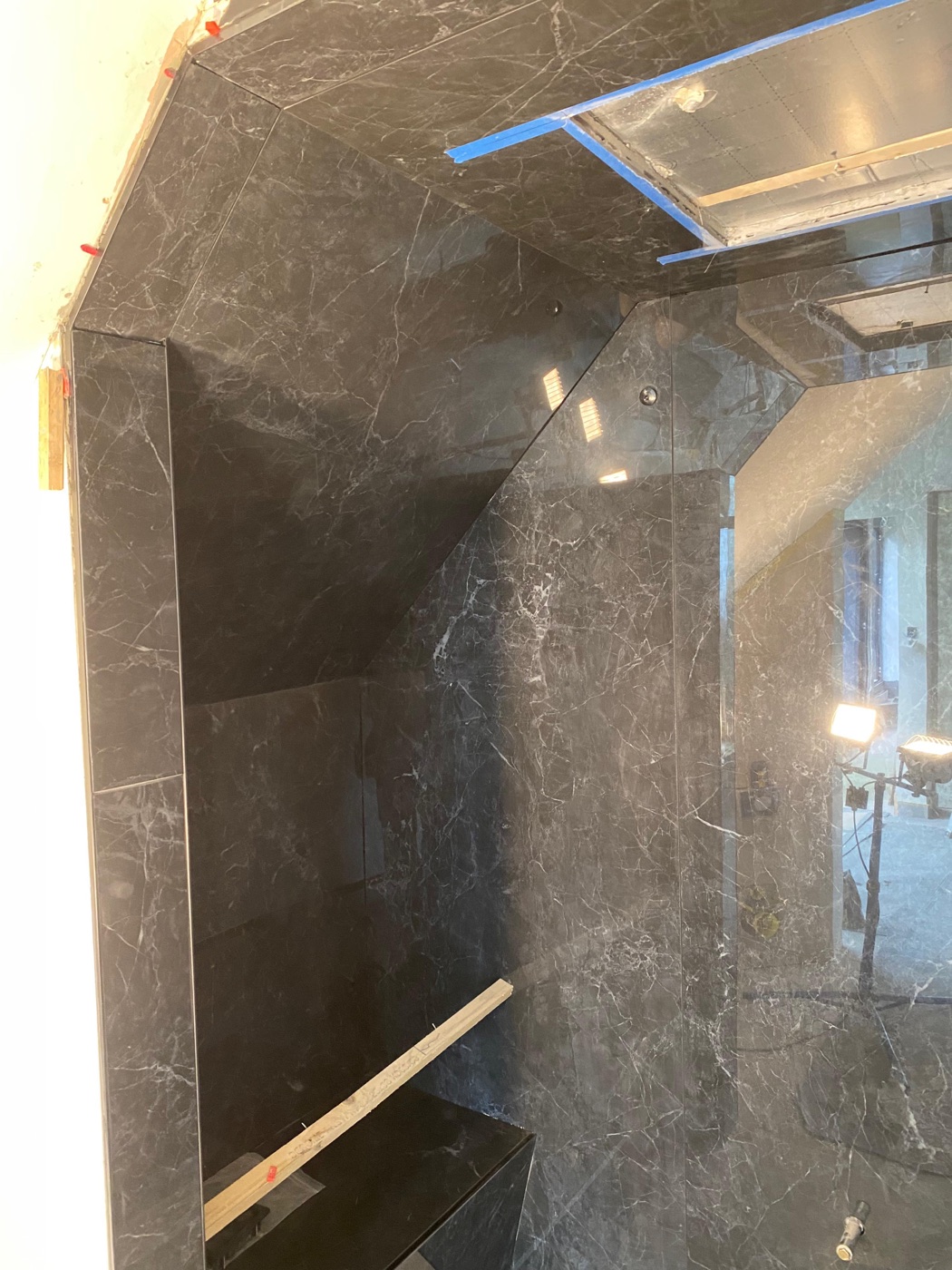 Black marble wet room, West Wickham — the same tile runs from floor up all four walls to the full height of a vaulted ceiling. A real tile drenching project, laid before the term existed. Wet room service
Why tile drenching works
The eye reads a room in parts. When the floor is one tile, the walls another, and there is a feature wall doing a third thing, you are aware of the individual decisions. The room feels composed. Tile drenching removes all of that. There is only one material. The space reads as a whole.
This does two things. It makes the room feel larger, because there are no visual breaks. And it makes even a functional room feel considered, because the commitment to one material is itself a design statement.
It also simplifies decision-making. Instead of coordinating three different tiles, a grout that works across all of them, and trim pieces at the transitions, you choose one thing and do it throughout.
Which tile types work best
Not every tile suits drenching. Here is what to consider:
Large format stone and marble effects work exceptionally well. A big slab-look porcelain tile carries across floor and walls with minimal grout lines. The material reads as continuous rather than tiled. This is currently the most popular direction for high-end wet rooms.
Zellige and handmade tiles are interesting in a drenched application. The variation in the tile from piece to piece means the room has texture throughout rather than being flat. Works best in smaller spaces where the handmade quality reads up close.
Plain matte porcelain is the most practical choice. Consistent colour and format, low maintenance, available in large formats. Less visually exciting than stone or zellige but very liveable.
Gloss tiles do not suit drenching. Five planes of reflective surface in a confined space is too much. The reflections compound across the room and the visual noise undermines the calm coherence you are trying to achieve.
Small mosaic tiles can work but need careful consideration. Drenching a shower enclosure in small hexagon mosaic reads as pattern-led rather than material-led. It works, but it is a different outcome.
What actually goes wrong
Tile drenching increases the complexity of a job significantly. These are the technical issues that matter:
Movement joints. When you drench floor and walls in the same tile, the joint between the floor and wall is critical. That is a change of plane and a point of stress. It must be siliconed, not grouted. Grout will crack. If a tiler fills that joint with grout, the tile will fail in time. I see this regularly on jobs that have been done wrong the first time.
Substrate preparation. Drenching exposes every imperfection in the substrate. Any bow in a wall, any unevenness in the floor, reads clearly when the same tile runs continuously. The prep work for a drenched room needs to be thorough. Floors typically need levelling compound. Walls may need boarding out.
Waterproofing in wet rooms. If you are drenching a full wet room, the tanking membrane goes across the floor and up the walls. The tile then goes on top. The sequence matters and cannot be cut. Read more about what tanking involves.
Grout consistency. One grout across five planes in the same colour. If the grout colour drifts slightly between batches or if mix consistency varies, it will be visible in a drenched room. I use the same batch for the whole job where possible.
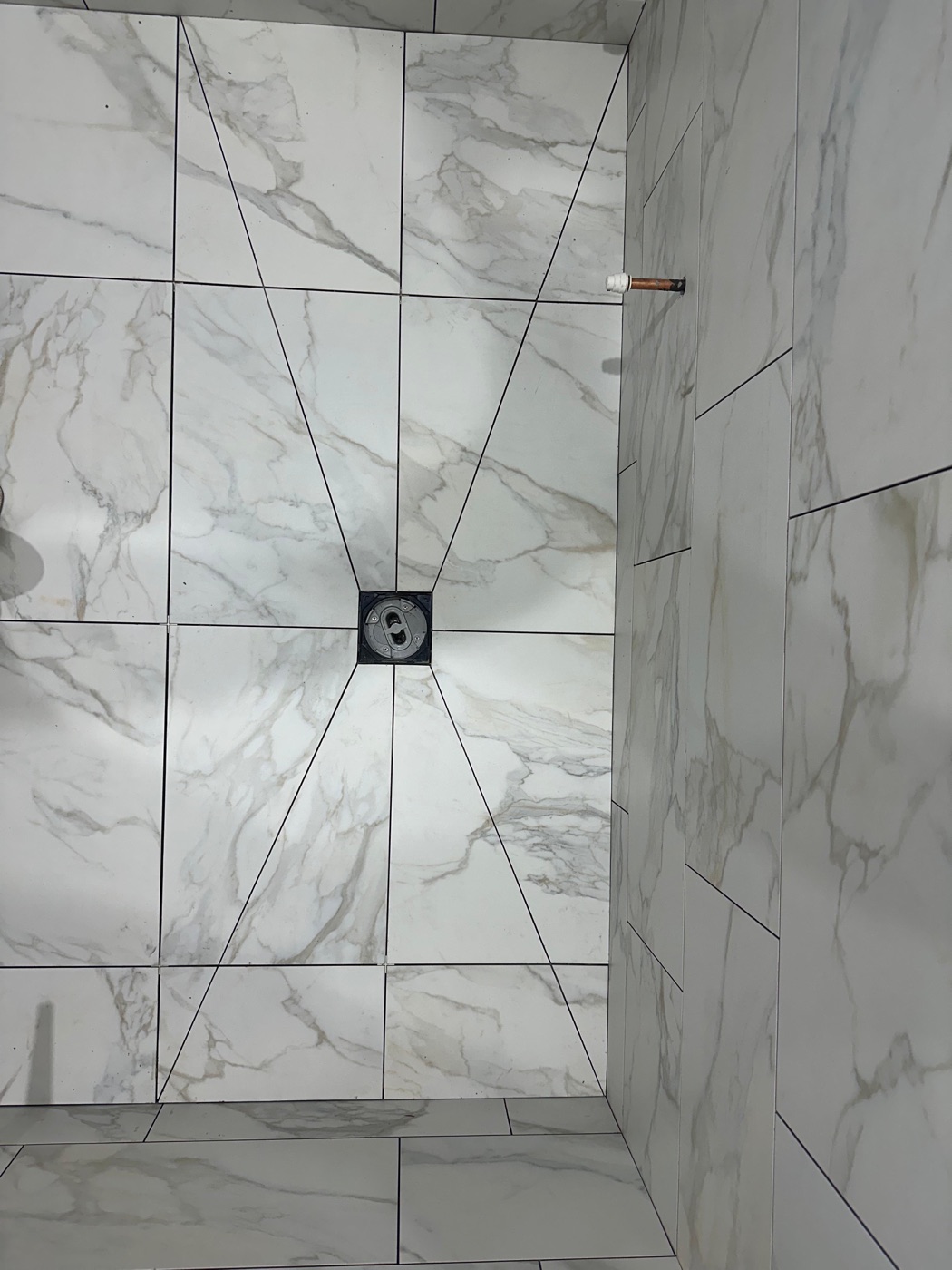 Calacatta marble wet room, Beckenham — full floor and wall tile in the same material, with a graded floor draining to a linear channel. Another tile drenching project. View marble and stone service
Tile drenching in a wet room vs a standard bathroom
In a full wet room with no shower tray, drenching is a natural fit. The floor already grades to a drain, the walls are tanked, and a continuous material across all surfaces is both practical and beautiful. Wet room installation and tile drenching are a natural pairing.
In a standard bathroom with a bath and separate shower, drenching is a bigger commitment. You are running the same tile behind the bath panel, across the floor, up all the walls. This works, but it requires a clear plan from the start because the substrate prep and sequence of work differs from a standard bathroom tile job.
Cost implications
Tile drenching costs more than tiling a bathroom with a floor tile and a separate wall tile. There are more surfaces, more cuts, and more technical detail at the transitions. For a bathroom of average size, expect to add roughly 20-30% to the tiling cost compared to a conventional approach, depending on the tile and the room.
The tile cost itself may actually be simpler. One tile bought in bulk is often cheaper than buying three different products at lower quantity.
For a realistic cost for your room, request a free quote. I will visit, assess the space, and give you a clear written price.
FAQ
What is tile drenching? Tile drenching means running the same tile across every surface of a bathroom or wet room: floor, all walls, and sometimes the ceiling. The effect is a coherent, immersive space where the material is the design.
Is tile drenching expensive? More expensive than a standard bathroom tile job, yes. More surfaces, more technical detail at the transitions, and more care needed with prep and consistency. Expect around 20-30% more than a conventional bathroom tile.
Can you tile drench with any tile? Not all tiles suit it. Large format stone-effect porcelain, zellige, and plain matte porcelain work well. Gloss tiles do not. The tile needs to read well on both horizontal and vertical surfaces.
Does tile drenching make a bathroom look bigger? Generally yes. A continuous material with no visual breaks between floor and wall makes the eye read the space as a whole rather than in parts. It is particularly effective in smaller bathrooms and shower enclosures.
Related reading: Bathroom tile trends 2026 · What is tanking and why does it matter? · Wet room vs shower tray · Wet room installation across South East London
Got a specific question? Call me on 07990 521717 , see the wet room service, or use the contact form — I'm happy to give advice with no obligation.