Outdoor and Patio Tiling in the UK: Frost-Proof Porcelain, Drainage, and What Survives British Weather
How to tile outdoor patios, pool surrounds, and porches in the UK. Frost-proof porcelain, drainage falls, expansion joints, and what goes wrong in British weather.
Outdoor tiling in the UK is a different discipline from indoor tiling. The British climate — freezing winters, driving rain, summer heat, constant moisture variation — destroys materials and installations that are not specifically designed for external exposure. I have seen outdoor tile jobs that looked perfect in June and were cracked by February.
This guide covers what works outdoors, what does not, and the specific technical requirements that prevent UK weather from ruining your investment.
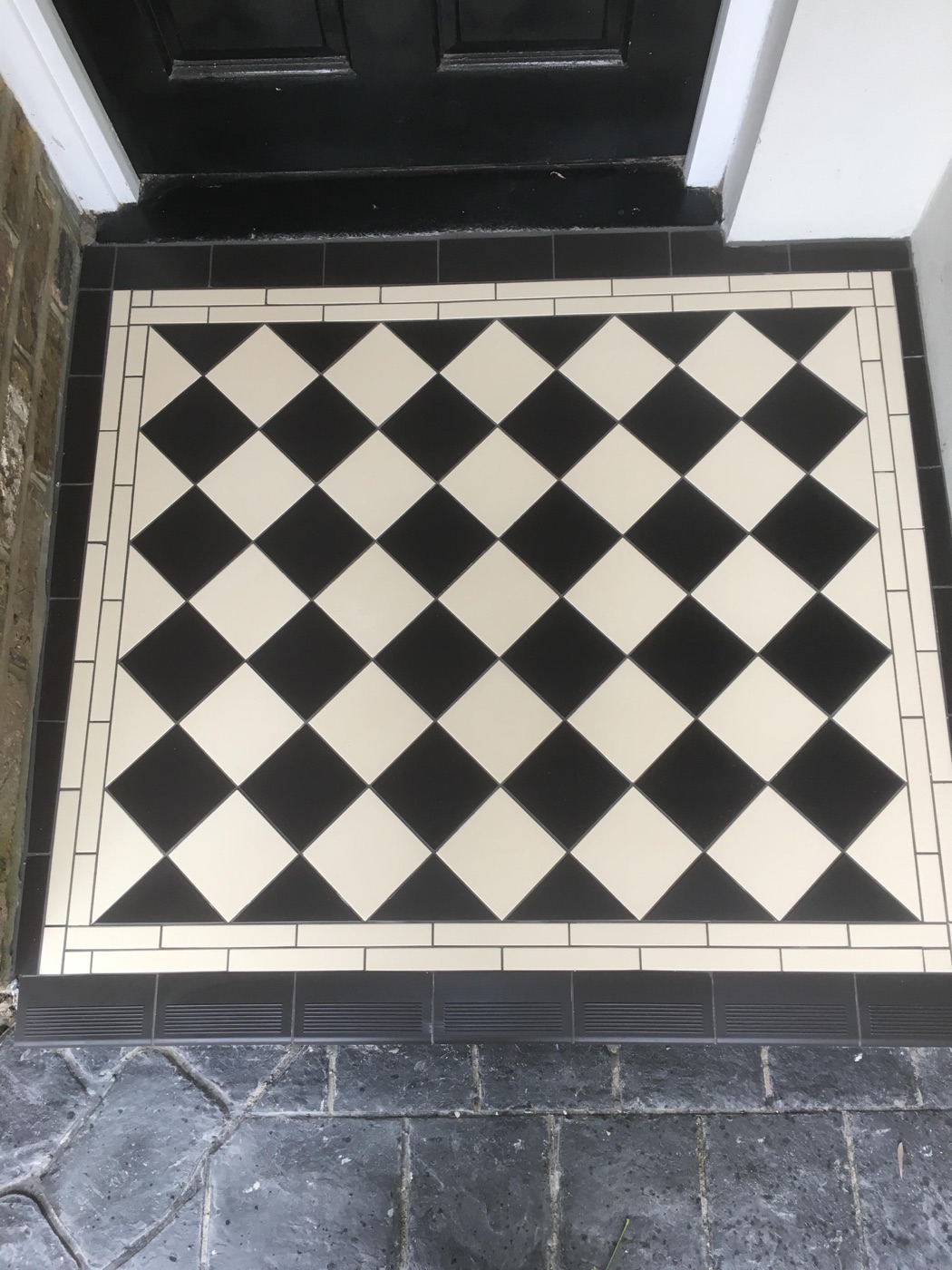 Victorian diamond pattern front path, Crystal Palace. External tile work that has survived decades because the original Victorian specification was correct: dense, low-porosity tile on a solid substrate with proper drainage falls. Pattern tiling service
The UK climate problem
The specific challenge for outdoor tiling in the UK is freeze-thaw cycling. Water is present in the air, in rain, and in ground moisture for the majority of the year. When temperatures drop below zero — which happens multiple times each winter across South East London and Kent — any water that has been absorbed into tile, adhesive, or grout expands as it freezes.
Expansion from freezing exerts enormous force. It cracks tiles, de-bonds adhesive, breaks grout joints, and can lift entire tiled surfaces from their substrate. The solution is not to hope for mild winters. The solution is to specify materials that do not absorb water.
Tile specification: frost-proof is non-negotiable
What frost-proof means
Frost-proof porcelain has a water absorption rate below 0.1%. At this level, the tile absorbs so little moisture that freeze-thaw cycling has no measurable effect. The tile is effectively impervious.
Standard indoor porcelain has a water absorption rate below 0.5% (the threshold for porcelain classification). This is low enough for indoor use but can be high enough for freeze-thaw damage outdoors. Not all porcelain is frost-proof.
Ceramic tiles have water absorption rates above 0.5%, often significantly higher. Ceramic tiles are never suitable for external use in the UK.
How to check
The product datasheet will state whether the tile is rated for external use or is frost-proof. If the datasheet does not mention external use, assume the tile is not suitable. Ask the supplier specifically. “Is this tile frost-proof and rated for external use in the UK?” is the question.
Manufacturers who produce outdoor-rated tiles include them in a specific range labelled “outdoor”, “external”, or “20mm” (the thicker format common for outdoor use).
20mm outdoor porcelain
Many manufacturers now produce a specific 20mm-thick outdoor porcelain range. These are the same tile design as the indoor range but in a thicker body that handles the mechanical loads of outdoor use (heavier furniture, vehicle access in some cases, ground settlement).
20mm tiles can be dry-laid on gravel or sand beds (no adhesive needed) as well as adhesive-fixed to a concrete substrate. The dry-laid approach is popular for patios because it allows easier replacement of individual tiles and does not require the same substrate preparation as adhesive fixing.
Substrate: concrete slab with correct falls
Concrete
A concrete slab is the standard substrate for outdoor tiling. The slab must be:
- Structurally sound. No cracks, no settlement, no movement.
- Correctly graded. The surface must slope away from the house at a minimum of 1:80 to shed water. Water pooling on the surface is the primary cause of outdoor tile failure.
- Properly cured. New concrete needs at least 28 days to cure before tiling. Tiling over green concrete risks adhesive failure as the concrete continues to dry.
- Clean and free of contaminants. Release agents, paint, oil, or moss prevent adhesive from bonding.
What about existing patios?
Tiling over existing concrete paving slabs is possible if the slabs are stable, level, and the falls are correct. Old crazy paving or uneven slabs need removing and replacing with a new slab.
Tiling over existing outdoor tiles (tile-on-tile externally) is not recommended. The bond between old tile and new adhesive is unreliable, and adding height affects the drainage falls.
Adhesive: external rated, full coverage
Outdoor adhesive must be:
- C2 rated for improved bond strength
- Frost-proof (rated for freeze-thaw cycles)
- Flexible (S1 minimum) to accommodate thermal expansion
- Applied in full-bed technique with back-buttering for 95%+ coverage
Why full coverage matters more outdoors than indoors: Any void behind the tile traps water. Trapped water freezes. Frozen water expands. The tile cracks at the void. Indoors, this is unlikely because water does not reach the adhesive bed. Outdoors, water is everywhere and finds every gap.
Grouting and jointing
Outdoor grout joints should be wider than indoor joints (3-5mm minimum) to allow water to drain through the surface rather than pooling on top.
Options:
- Flexible outdoor grout (cementitious, frost-proof rated). The standard approach for adhesive-fixed tiles on a concrete slab.
- Permeable jointing compound (resin-bonded sand). Used for dry-laid 20mm tiles on gravel beds. Allows water to drain through the joints while holding the joint material in place.
- Open joints (no grout, just the gap). Used for dry-laid tiles on gravel where the gaps are intentional and the tile sits on the substrate without any joint filler.
Expansion joints
Thermal expansion outdoors is significantly greater than indoors. A patio tiled surface in direct summer sun can be 40-50 degrees Celsius. In winter frost, the same surface is below zero. This temperature range causes expansion and contraction that rigid installations cannot accommodate.
Expansion joints at:
- The perimeter (against all walls, steps, and raised beds)
- Every 3-4 metres across the surface in both directions
- Around any fixed elements (drain covers, post bases, steps)
Expansion joints are filled with flexible outdoor sealant, not grout.
Pool surrounds
Pool surrounds are one of the most demanding external tiling applications. The tile faces:
- Constant moisture from pool water
- Pool chemicals (chlorine, salt, pH adjusters)
- Frequent wet foot traffic (maximum slip hazard)
- Direct sun exposure (thermal expansion)
- Freeze-thaw cycling in winter
Specification:
- Frost-proof porcelain (below 0.1% water absorption)
- R11 or R12 slip rating (non-negotiable around a pool)
- C2 S1 frost-proof adhesive with full back-buttering
- Chemical-resistant grout (epoxy or specific pool-rated cementitious)
- Drainage falls away from both the pool and the house
This is specialist work. A pool surround installed incorrectly is both a safety hazard (slip risk) and a durability failure (tiles lifting in the first winter).
Front paths and porches
Victorian and Edwardian front paths across South East London were originally tiled in quarry tile, encaustic cement tile, or geometric ceramic. Many of these original installations have lasted over a century because the specification was inherently correct: dense, low-porosity materials on a solid base.
Modern reproductions of period path tiles are available in frost-proof porcelain. These give the Victorian aesthetic with contemporary freeze-thaw performance. See tiling in Victorian and Edwardian houses.
For front porches and covered external areas, the specification is the same as fully exposed surfaces. Even a covered porch gets rain blown in, frost, and temperature variation.
What I do and do not install outdoors
I install:
- Front paths and porches in frost-proof porcelain
- Pool surrounds with correct specification
- Small patio areas connected to kitchen or conservatory extensions
- Steps and thresholds at external doors
I do not install:
- Large patio areas over 30 square metres (this is landscaping rather than tiling and benefits from a landscape specialist with machinery)
- Driveways (require vehicle-rated materials and engineering)
- Areas without a prepared concrete substrate
For outdoor tiling in Bromley and South East London, get in touch for a site visit. I will assess the substrate, the drainage, and the exposure before recommending a specification.
See also: porcelain vs ceramic tiles | types of tiles explained | best tile adhesive
Got a specific question? Call me on 07990 521717 , see the outdoor and patio tiling service, or use the contact form — I'm happy to give advice with no obligation.