Kitchen Tiles: The Definitive Guide to Floors, Splashbacks and Getting It Right
Everything about kitchen tiles in one place: floor materials, backsplash options, patterns, grout choices, underfloor heating, and what to watch out for. Practical advice from a South East London tiler.
Kitchen tiles are a different problem to bathroom tiles. The environment is different: heat from the hob, grease from cooking, heavy foot traffic, dropped items, and more varied moisture than a bathroom (wet at the sink, dry at the other end of the room). The choices you make in a kitchen need to account for all of that.
This guide covers kitchen floor tiles, kitchen splashback tiles, and everything between: materials, formats, patterns, grouting, underfloor heating, and the mistakes that cause problems.
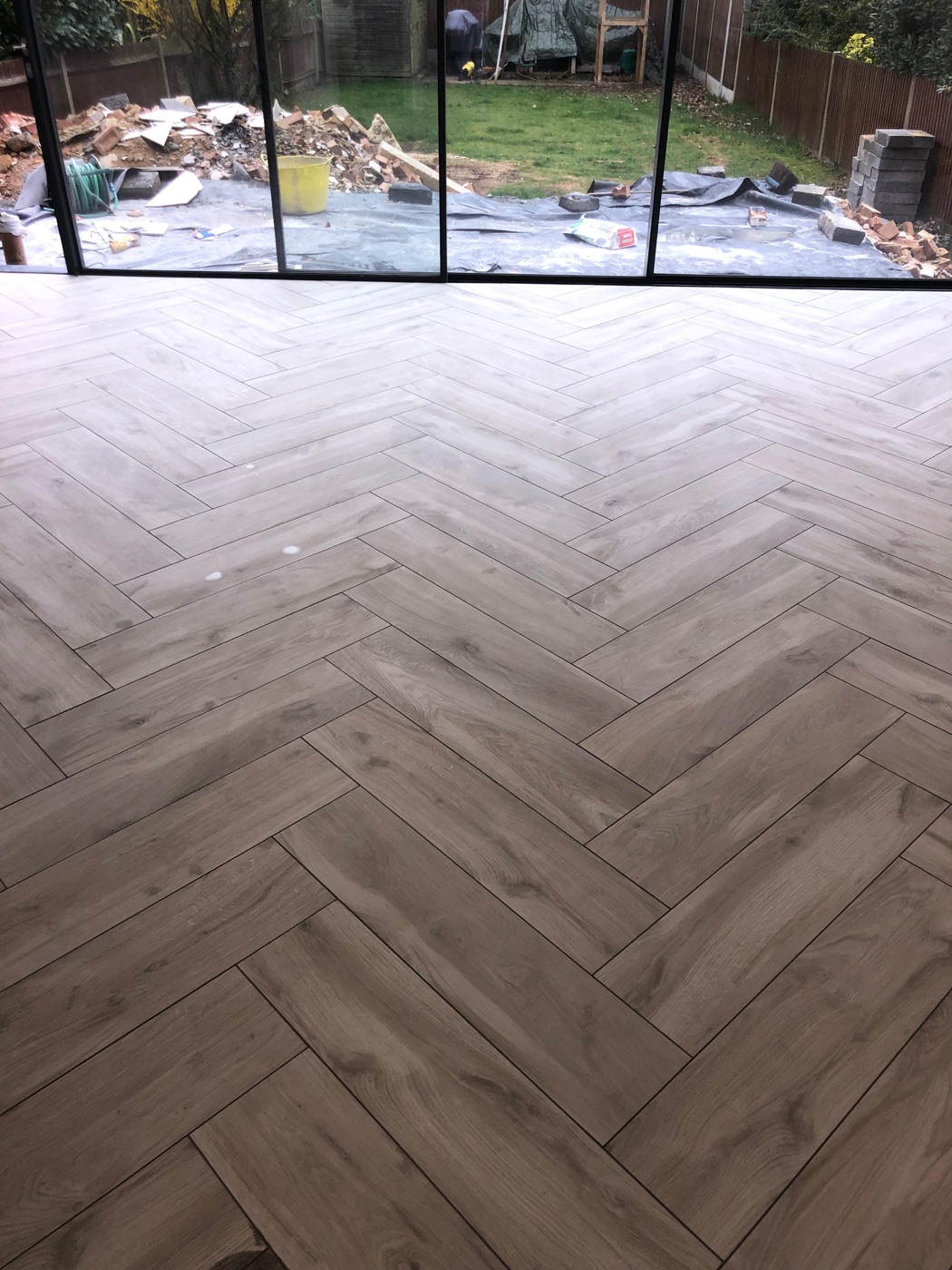 Grey herringbone porcelain kitchen floor, Orpington — laid on a decoupling membrane over a timber subfloor. Large open-plan kitchen, full room in herringbone, dark grout joints. Getting the floor right in a kitchen matters more than people realise. Kitchen floor tiling service
Kitchen floor tiles: what works
Material choices for kitchen floors
Porcelain is the best all-round choice for kitchen floors. It is non-porous, resistant to grease and cleaning products, hard enough to handle dropped pots and heavy appliances, and available in every style including convincing stone and wood effects. For a kitchen that needs to be practical, beautiful, and easy to maintain, porcelain is the answer.
Large format porcelain (600x600, 600x1200, 800x800) is currently the dominant direction for kitchen floors, particularly in open-plan spaces. Fewer grout lines, cleaner look, reads as a continuous surface. Requires a very flat substrate.
Natural stone (limestone, slate, travertine, marble) can be used in kitchens but requires more maintenance. Stone needs sealing and regular re-sealing. Kitchen environments with grease and acid from food are harder on stone than a bathroom. For a larder, a utility room, or a period kitchen that suits the material, stone is a good choice. For a high-use family kitchen, porcelain with a stone effect is more practical.
Terracotta suits period and farmhouse kitchens. It is porous and needs consistent sealing but the warm earthy look is authentic and holds up well in the right setting. More common in the tiles of older Bromley, Beckenham, and Orpington homes I am called to restore or replicate.
Kitchen floor tile formats
Large format (600mm and above): Best for open-plan spaces. Makes the room read as larger. Requires a genuinely flat substrate; any unevenness reads clearly under large tiles.
Standard format (400x400, 300x600): Versatile, manageable to lay, suits most kitchen sizes.
Herringbone (typically 100x200 or 100x400): One of the most popular kitchen floor patterns right now. The grey herringbone kitchen floor in Orpington is one of my most frequently referenced jobs. Read more: herringbone tiles in bathrooms (the pattern applies equally to kitchens).
Checkerboard: Square tiles in two contrasting tones in an alternating pattern. Traditional, suits period kitchens, strong graphic effect. Setting-out from the centre is critical.
The subfloor problem in kitchens
Kitchen floors in South East London are often timber-joisted. This is the most common substrate issue I deal with in kitchen tiling.
Timber floors flex. Tiles do not. When you fix a rigid tile onto a substrate that bends under load, the tile or the grout joint eventually cracks. This is not a question of when: it is a question of how soon.
The correct solution is a decoupling membrane between the timber and the tile. The membrane accommodates the slight movement in the timber without transmitting it to the tile. On top of a decoupling membrane, correctly laid with correct adhesive and grout, tile can last indefinitely on a timber floor.
Read more: why tiles crack
Underfloor heating in kitchen floors
Electric and wet UFH systems both work under tile, and tile is the best material to use with UFH because of its high thermal mass. The heat is retained in the tile and radiates slowly and evenly.
The critical requirements:
Correct adhesive. A C2S1 or higher flexible adhesive is required. Standard rigid adhesive will fail under the repeated thermal cycling as the system heats and cools.
Correct screed curing. On a newly poured screed over a wet UFH system, the screed must cure and the UFH must be run at low temperature for an extended period before tiling. Skip this and the screed retains moisture that tries to escape after tiling, causing adhesive failure.
Expansion joints. Tile over UFH expands and contracts with each heating cycle. Movement joints at perimeters and at internal columns or changes of plane are essential.
Full detail: tiling over underfloor heating
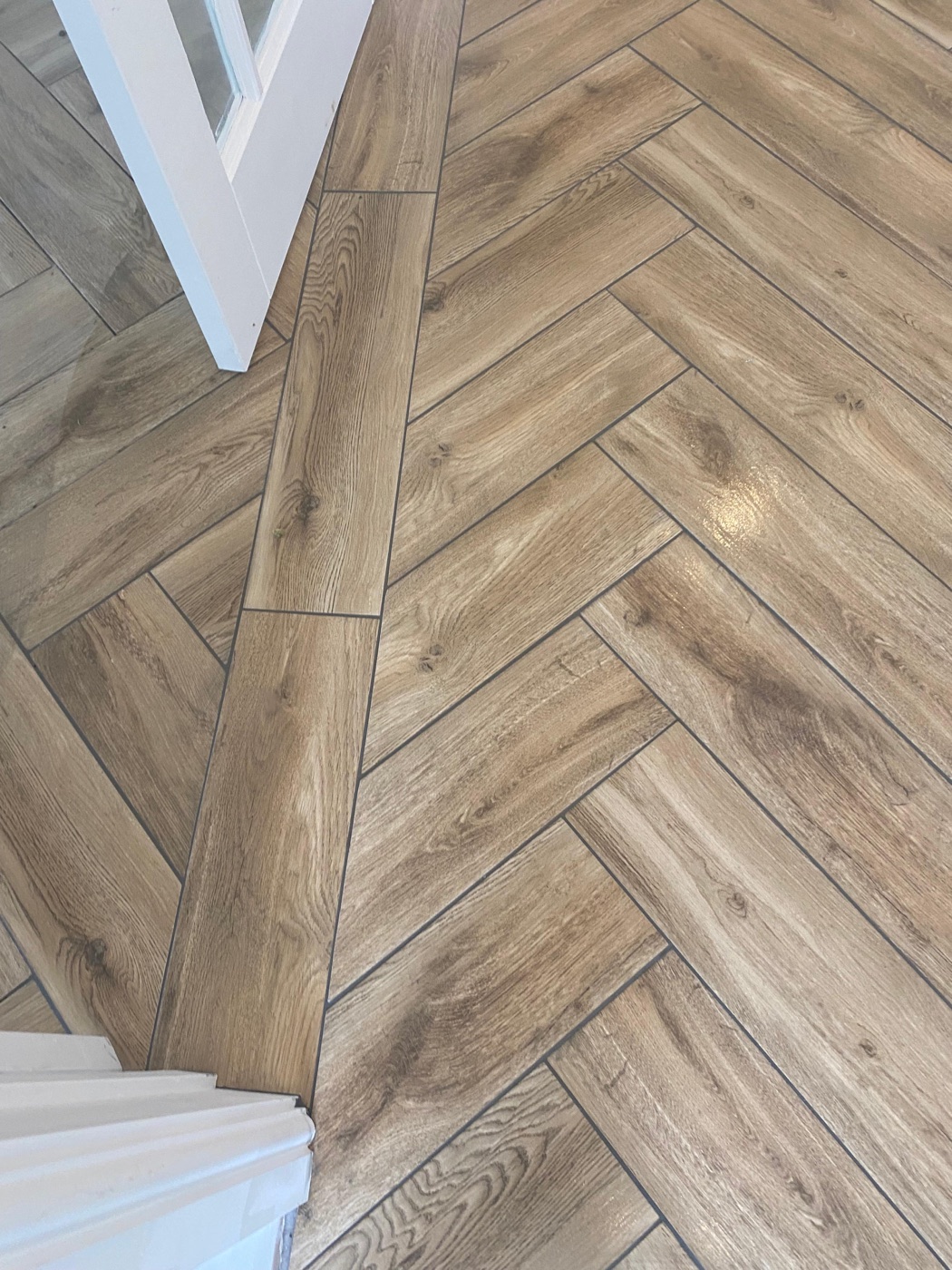 Oak-effect porcelain herringbone, Petts Wood — the same warm-toned herringbone that works in hallways translates directly to kitchens. Warm planks with dark grout, long and narrow format showing the pattern clearly. View more herringbone work
Kitchen splashbacks: what works
The backsplash is the tile surface most people look at most in a kitchen. It is in your direct eyeline at the hob and the sink. It also takes the most abuse: heat, grease, cleaning products, steam.
Material choices for kitchen splashbacks
Porcelain and ceramic are the most practical. Non-porous, easy to clean, handles the heat and grease of a cooking environment without issue.
Zellige is currently the most requested material for kitchen splashbacks in characterful properties. The handmade quality and light response are exceptional. Needs sealing and a good stain-resistant grout, but it is practical in this application. Read more: zellige tiles: everything you need to know
Natural stone is beautiful but needs more maintenance near a hob. Grease and acid from cooking affect unsealed stone. Regular resealing is required.
Glass tile is non-porous and very easy to clean. Contemporary look. Less popular currently than in 2015-2020 but still a clean, practical choice.
Splashback patterns and layouts
Herringbone rectangular tile is the most popular pattern on kitchen splashbacks. 75x150 or 75x300 in a warm tone reads well above a kitchen worktop.
Vertical stack bond (rectangular tile running vertically with aligned joints) looks architectural and slightly unexpected. Works well in contemporary kitchens.
Large format straight lay from worktop to ceiling reads clean and quiet. Good for kitchens where the cabinetry or the worktop is doing the visual work.
Feature panel behind the hob in zellige or a statement tile, with a plainer tile elsewhere on the run, is a practical and popular approach.
Read more: kitchen backsplash tile ideas for 2026
Grout in kitchens
Kitchen grout takes more punishment than bathroom grout. It deals with grease, food, and cleaning products daily.
I use an epoxy or epoxy-hybrid grout in kitchens where the customer is willing to pay for it. It is significantly harder to apply than standard cement grout but it is almost impervious to staining and requires very little maintenance. For a kitchen that is in daily use, it is worth the extra cost.
If a standard cement grout is used, choose a stain-resistant formulation and seal it properly at installation. Light grout in a high-use kitchen turns grey with time. A mid-tone or dark grout ages better.
Coordinating floor and wall tiles
The floor tile and the splashback tile do not need to match but they need to work together. Common approaches:
Same tone, different format. A warm large format floor tile with a smaller zellige splashback in a similar tone reads coherent without being identical.
Neutral floor, statement splashback. A plain matte floor lets a feature splashback do the work. The kitchen in Orpington with a grey herringbone floor would suit a warm-tone zellige splashback that picks up the warmth without competing with the floor.
Same tile, floor to ceiling. In a small kitchen this can feel immersive and deliberate rather than monotonous. Choose a tile that reads well on both planes.
Cost overview for kitchen tiling
Kitchen tiling costs depend on the floor area, the substrate condition, the tile choice, and the pattern. See how much does tiling cost in 2026? for a full breakdown.
The substrate is particularly important in kitchens. Timber floors that need a decoupling membrane, UFH systems that need specific adhesive, and older properties with uneven surfaces all affect the preparation required before any tile goes in.
I offer free quotes across Bromley, Beckenham, Orpington, Chislehurst, and surrounding areas. Contact me and I will visit and give you a clear written price.
FAQ
What is the best kitchen floor tile? Porcelain is the most practical: hard, non-porous, resistant to grease and dropped items. Large format porcelain in a warm stone tone is currently the dominant choice for contemporary kitchens.
Can I tile over a timber kitchen floor? Yes, with a decoupling membrane. Without it, the flex in the timber will crack the tile or the grout. With a correctly installed membrane and the right adhesive, tiled timber floors last indefinitely.
What kitchen splashback tile is best for 2026? Zellige in amber or warm sage for characterful kitchens. Large format matte porcelain for contemporary clean kitchens. Herringbone rectangular tile for a pattern-led approach. See kitchen backsplash tile ideas 2026.
Does underfloor heating work with all tile types? Yes, but the installation requirements change. You need a flexible C2S1 adhesive and properly cured screed. Natural stone over UFH needs the same requirements plus movement joints and sealing.
Related reading: Kitchen backsplash ideas 2026 · Kitchen floor tile guide · Underfloor heating tiles · Why tiles crack · Kitchen floor tiling service · Underfloor heating preparation service
Got a specific question? Call me on 07990 521717 , see the kitchen floor tiling service, or use the contact form — I'm happy to give advice with no obligation.