Herringbone Tiles in Bathrooms: Why This Pattern Dominates and How to Use It Well
Herringbone is the most requested tile pattern in bathrooms right now. This is what it looks like in practice, which tiles suit it, what it costs extra, and how to avoid the mistakes.
Herringbone bathroom tiles are the most requested pattern I get asked about across Bromley and South East London. That has been true for several years now and in 2026 the interest is, if anything, stronger. It works in both classic and contemporary settings, it suits a wide range of tile types, and when it is laid well it transforms an ordinary room.
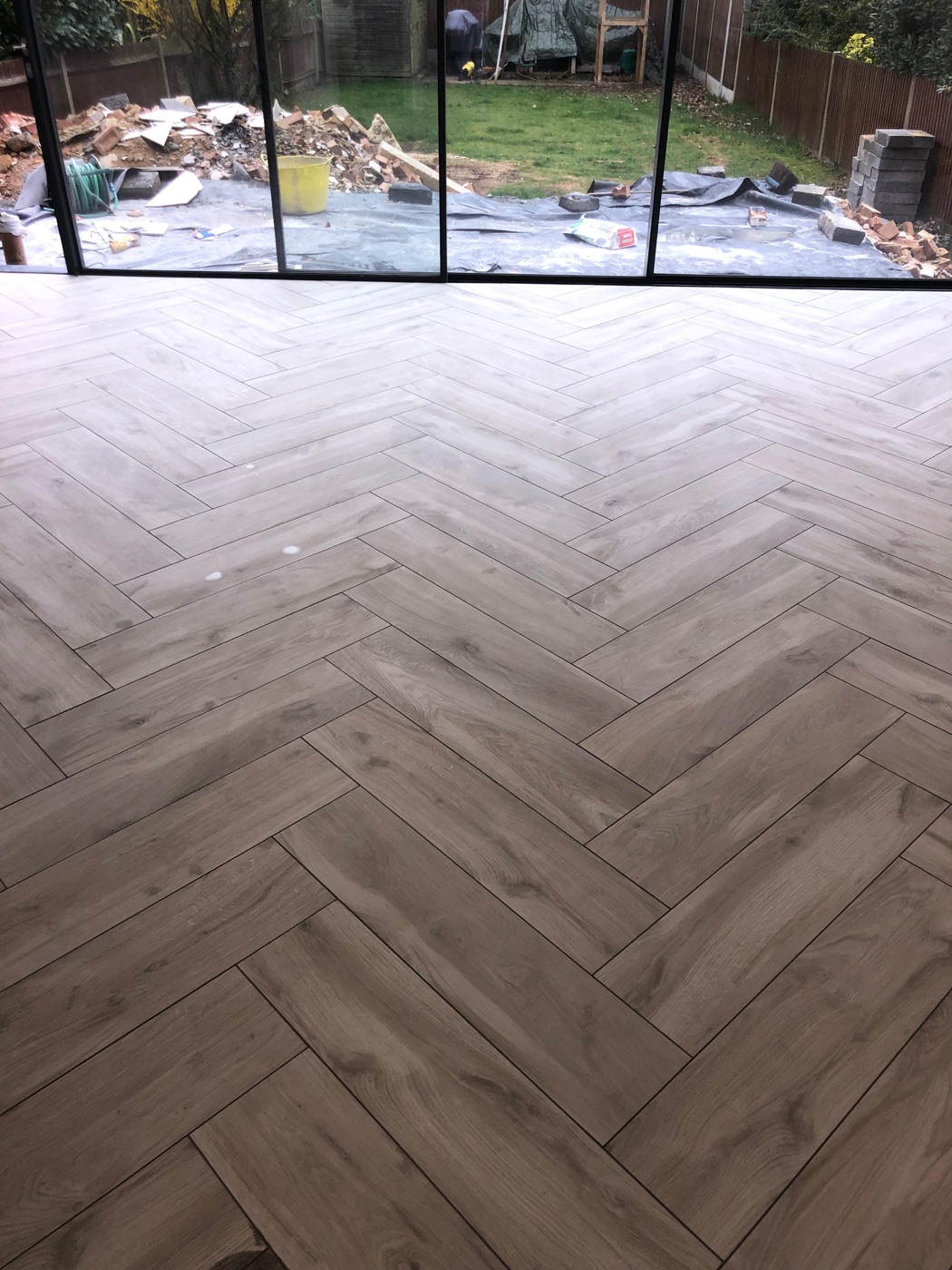 Grey porcelain herringbone floor, Orpington — the same pattern that works in bathrooms and hallways reads equally well in open-plan kitchens. Laid over a decoupling membrane on a timber subfloor. Kitchen floor tiling service
Here is what you actually need to know before you commit to it.
What herringbone looks like in a bathroom
Herringbone is a V-shaped interlocking pattern using rectangular tiles. The tiles meet at 90 degrees with each tile laid perpendicular to the last, creating the characteristic arrow or zigzag direction.
There are two orientations:
45-degree herringbone runs the pattern diagonally across the room. More traditional, more dramatic. Good for period properties and larger spaces. The diagonal direction gives a room movement and energy.
90-degree herringbone runs the V-pattern parallel to the walls. Less dramatic than 45 degrees but still clearly herringbone. Works well in contemporary settings and in narrow spaces where a strong diagonal would feel busy.
In a bathroom, herringbone is used most often on:
- The shower floor (small format, often mosaic sheets)
- Feature shower wall
- Bathroom floor throughout
- Above the bath as a splashback
Which tiles suit herringbone
The tile format is critical. Herringbone reads well when the individual tiles are clearly rectangular with a strong length-to-width ratio. The pattern only makes visual sense when you can read the direction of each tile.
75x150mm or 75x300mm is the most common format for wall herringbone. Clear length-to-width ratio, the V-pattern reads strongly, and the tiles are a manageable size at the perimeter cuts.
100x200mm or 100x400mm gives a slightly more contemporary scale, particularly on floors. The larger format reduces the grout line frequency and looks cleaner.
Mosaic sheets in a small brick format (around 25x50mm or 48x98mm) are used in showers, particularly on the floor. The small format grips in a wet environment and the herringbone pattern adds visual interest in a confined space.
Large format tiles do not suit herringbone. A 600x300 tile in herringbone produces very large off-cuts at the perimeter and the pattern becomes hard to read. At that scale, a straight brick bond offset reads better.
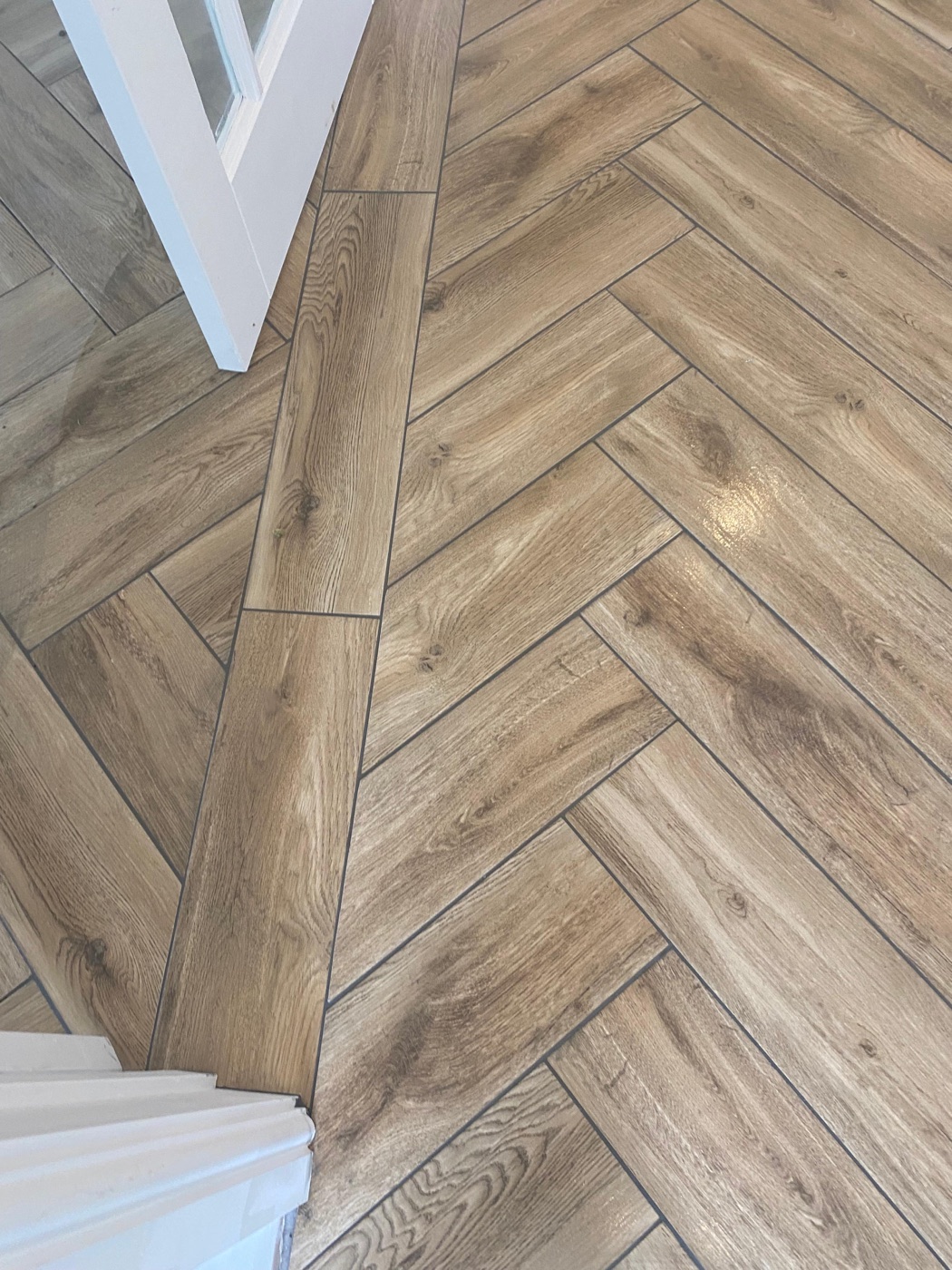 Oak-effect porcelain planks in herringbone, Petts Wood — warm tone with dark grout joints across an entrance hallway. The same pattern translates directly to bathroom floors and shower enclosures. Pattern tiling service
What herringbone costs compared to straight lay
I covered this in detail in herringbone vs straight lay for hallways, but for bathrooms the same principle applies: expect herringbone to cost 20-35% more in labour than a straight lay of the same tile.
The reasons are practical:
More cuts. At 45 degrees, every tile along the perimeter needs an angled cut. In a bathroom with a lot of edge relative to field, this adds up significantly.
More time. Maintaining a consistent V-pattern requires care and frequent checking. Drift accumulates. I use a string line and check constantly.
More wastage. Angled cuts produce more off-cuts. Budget 15-20% wastage on a herringbone floor versus 10% for straight.
On a standard bathroom floor of around 4-5 square metres, the extra cost is real but not prohibitive. On a shower floor in a smaller format, the additional labour is proportionally higher because the tile size increases cut frequency.
Herringbone on shower walls
Herringbone on a feature shower wall is one of the most effective uses of the pattern. A single wall behind the shower head in herringbone while the other walls run straight creates contrast without complexity. This is easier to install than a full herringbone bathroom and the visual impact is strong.
For this application, I usually recommend 75x300 or 100x200 wall tiles in a warm tone or a natural stone effect. The pattern adds enough interest that you do not need a busy tile. A simple warm matte tile in herringbone reads very well.
Mistakes to avoid
Wrong format tile. Square tiles do not work for herringbone. Neither do very large format tiles. The format needs to be clearly rectangular.
No starting point planned. A herringbone bathroom floor needs a planned centre. If you start from the wrong point, you end up with awkward cuts at the most visible edge. I always find the centre of the room and work outward, confirming with the customer where the pattern should sit before laying a single tile.
Grout colour that fights the pattern. Herringbone depends on the grout line to read as a pattern. Too wide a grout line makes it look busy; too narrow and the pattern disappears. Match the grout colour to the tile tone, slightly darker rather than lighter, and keep lines consistent.
Insufficient substrate prep. Herringbone at 45 degrees on a floor exposes any unevenness in the substrate clearly. The diagonal direction catches the light across angled cuts and any height variation is visible. The floor needs to be genuinely flat before a herringbone lay.
Is herringbone right for your bathroom?
It is the right choice if you want the room to have character and the tile format suits it. For period properties across Bromley, Beckenham, Chislehurst, and Orpington it is often a natural fit. For contemporary bathrooms it works equally well in the right tile and scale.
It is not the right choice if budget is very tight, because the extra labour cost is real, or if the tile you have already chosen is a large format that does not lend itself to the pattern.
If you want to discuss whether herringbone suits your specific room, get in touch for a free quote. I will tell you honestly.
FAQ
Is herringbone tile more expensive to install? Yes. Expect 20-35% more in labour cost than an equivalent straight lay. The angled cuts, extra time to maintain the pattern, and higher wastage all contribute.
What size tile is best for herringbone in a bathroom? 75x150, 75x300, or 100x200 for walls. 100x200 or 100x400 for floors. Small mosaic brick format for shower floors. Avoid square tiles and very large format tiles.
Can herringbone tiles go on a shower floor? Yes. Small format brick mosaic sheets in herringbone are common on shower floors. They grip well in a wet environment and the small format accommodates the drain slope.
What grout colour works best with herringbone? Match to the tile or go slightly darker. Avoid bright contrasting grout, which makes the pattern too busy. Keep lines consistent at around 2-3mm for wall tiles.
Related reading: Herringbone vs straight lay for hallways · Bathroom tile trends 2026 · Bathroom tiling across Bromley and South East London · Pattern tiling and complex setting out
Got a specific question? Call me on 07990 521717 , see the pattern tiling service, or use the contact form — I'm happy to give advice with no obligation.