Hallway Tile Ideas: First Impressions, Durability, and What Actually Lasts
Practical hallway tiling ideas for UK homes. Materials, patterns, colours, and what survives 20 years of muddy shoes, pushchairs, and school bags.
The hallway is the first tiled surface anyone sees when they walk through your front door. It sets the tone for the entire house. It also takes more punishment per square metre than any other floor in the building — every pair of shoes, every bag dropped, every pushchair wheeled in, every delivery left inside the door.
Getting the hallway right means choosing a tile that looks good on day one and still looks good on day three thousand. This guide covers what works, what lasts, and what the patterns and colours actually look like in real South East London homes.
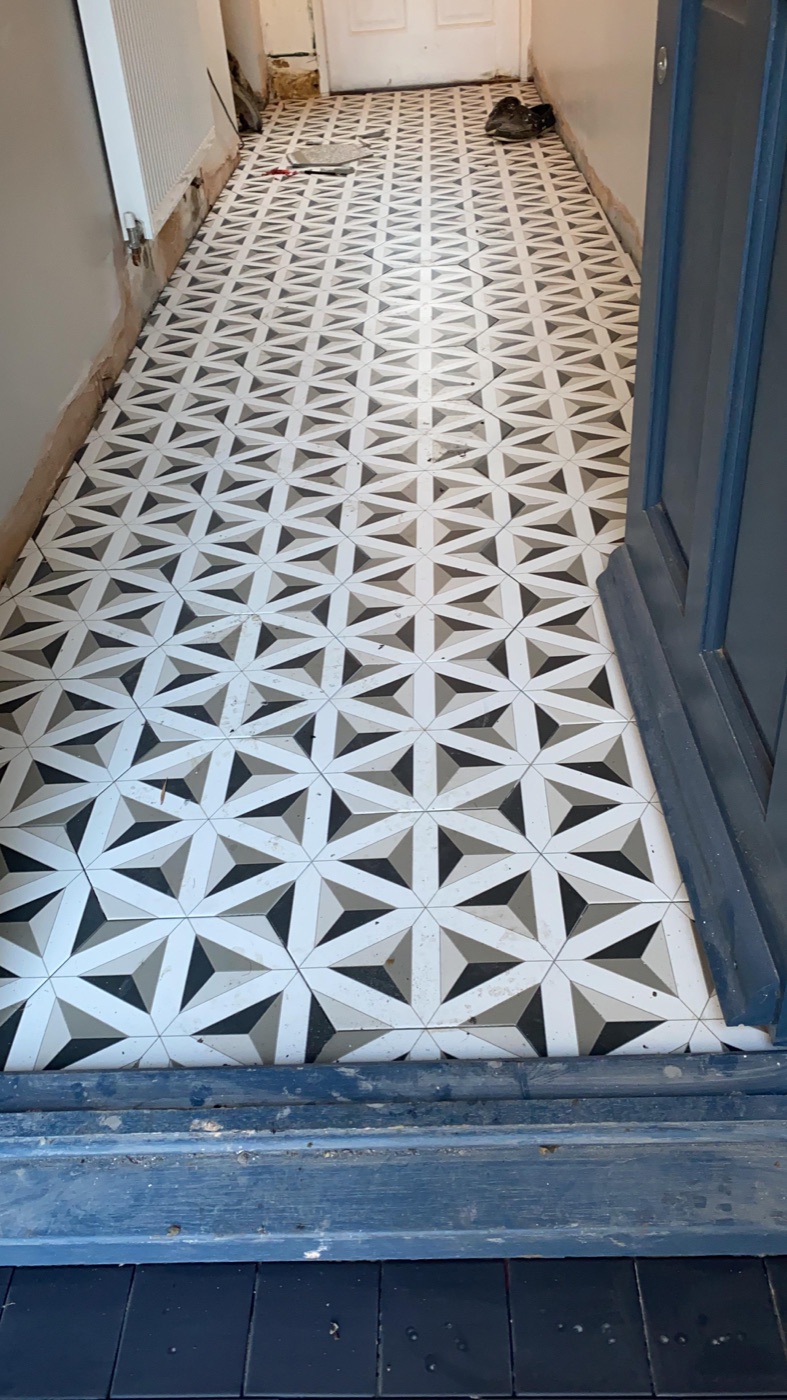 Victorian geometric star hallway, Chislehurst. A multi-piece pattern centred from the front door. The preparation and setting-out for a job like this takes as long as the laying itself. The result is a floor that reads as part of the house’s character rather than an afterthought. Pattern tiling service
Material choice: porcelain wins
For a hallway floor, porcelain is the right answer in almost every situation.
Why porcelain: Non-porous, so it does not absorb water from wet shoes. Hard enough to resist scratches from grit tracked in from outside. Dense enough to handle dropped keys, shopping bags, and the daily impact of family life. Resistant to cleaning products. Available in every style from stone effect to wood effect to geometric pattern.
Why not ceramic: Ceramic is softer and more porous than porcelain. In a hallway — a high-traffic, high-impact zone — ceramic chips more easily, shows wear faster, and absorbs moisture from wet footwear. The cost difference between porcelain and ceramic is modest. The durability difference is significant. See porcelain vs ceramic tiles.
Why not natural stone: Natural stone (limestone, slate, marble) is beautiful in hallways but requires sealing and more maintenance than porcelain. Stone is appropriate when the aesthetic is specifically period restoration or premium luxury and the homeowner accepts the care commitment. For most families, stone-effect porcelain gives a convincing visual result with none of the maintenance. See natural stone tile care.
Wood-effect porcelain is increasingly popular for hallways. It gives the warmth of timber with the durability of porcelain. In a herringbone pattern, it creates a statement entrance. See wood effect porcelain tiles.
Pattern: what the hallway shape dictates
The proportions of the hallway determine which patterns work.
Narrow hallway (under 1.2m wide)
Most Victorian and Edwardian terraces across Bromley and South East London have narrow front-to-back hallways. Pattern choice matters here because the space is tight and the eye needs to be drawn forward, not sideways.
Best options:
- Plank tiles running parallel to the walking direction (elongates the space)
- 90-degree herringbone (V-pattern pointing forward, creates movement)
- Straight lay brick bond with the long tile axis parallel to the hall
Avoid:
- 45-degree herringbone in very narrow halls (too visually active)
- Large geometric patterns (overwhelm the space)
- Large format tiles wider than the hallway is narrow (disproportionate)
Wide hallway (1.5m+ wide)
Larger entrance halls in detached and semi-detached houses have room for more expressive patterns.
Best options:
- Victorian geometric patterns (the most characterful option for period properties)
- 45-degree herringbone (dramatic, draws attention to the floor as a feature)
- Encaustic-effect patterned tiles with a border
- Large format straight lay for a contemporary minimal look
L-shaped or complex hallways
Hallways with turns, alcoves, or stairs present layout challenges. The pattern needs to flow around corners without creating awkward cuts or breaking the visual rhythm.
Best options:
- Straight lay or brick bond (simplest to navigate around corners)
- Geometric patterns with a border that absorbs the turns
- Herringbone works but needs careful planning at direction changes
Colour for hallways
Light tones
Cream, sand, light grey, and pale stone effects make hallways feel brighter and more spacious. They show dirt more visibly than dark tones, which means more frequent cleaning or acceptance of visible marks between cleans.
Mid tones
Warm grey, greige, mid-brown wood effect, and taupe are the practical middle ground. They hide marks and scuffs well while still reflecting enough light to keep the hallway feeling open. This is the range I recommend most often for family hallways.
Dark tones
Charcoal, dark slate, and dark stone effects are dramatic and hide marks exceptionally well. In a hallway with limited natural light, they can make the space feel dark and enclosed. In a hallway with a glazed front door or side lights, they can look exceptional.
Patterned
Encaustic-effect patterned tiles bring Mediterranean or Victorian character. They work as the focal point of the hallway. Pair with plain walls and minimal other decoration so the floor does the talking.
The substrate question
Hallways in older properties across Bromley and South East London present specific substrate challenges.
Victorian and Edwardian terraces typically have suspended timber floors in the hallway. These flex with foot traffic and expand/contract seasonally. Tiles installed directly onto a flexing timber floor will crack within a year. A decoupling membrane is essential. See tiling in Victorian and Edwardian houses and why tiles crack.
1930s semis often have solid concrete floors at ground level, which are excellent substrates for tiling. Check for damp (rising damp in older concrete) and apply a DPM (damp proof membrane) if needed.
Modern properties typically have concrete slab ground floors that are straightforward to tile after checking for flatness and applying levelling compound if needed.
Transition details
Where the hallway meets other rooms, the transition needs a clean detail.
Same tile continues into the next room: The cleanest option. No threshold strip needed. The floor reads as continuous across the ground floor.
Different flooring in adjacent rooms: A threshold strip (metal, stone, or matching tile) provides a clean break. The strip sits at the door position and creates a defined boundary. Match the strip finish to the door hardware if possible.
Step up or step down: Some older properties have level changes between the hallway and adjacent rooms. A well-executed tile transition at a level change prevents a trip hazard and looks intentional.
My hallway recommendations
Victorian terrace, narrow hallway: Oak-effect porcelain plank in 90-degree herringbone, warm mid-tone, matte finish. Decoupling membrane on timber subfloor. Dark grout matching the darkest tone in the plank.
1930s semi, standard hallway: Stone-effect porcelain in 600x600 or 600x300, warm greige, matte finish. Straight lay brick bond. Continue into kitchen if open plan.
Detached house, generous entrance: Victorian geometric star or diamond pattern in period-appropriate colours, or 45-degree herringbone in premium porcelain plank. Statement floor that sets the character of the house.
Modern property, contemporary style: Large format porcelain (600x1200) in matte concrete effect, light grey or warm sand. Straight lay stack bond with tight rectified joints. Minimal, architectural feel.
For hallway tile recommendations specific to your property, get in touch for a free site visit. I assess the substrate, the proportions, and the design context before recommending a material and pattern.
See also: floor tile patterns compared | herringbone vs straight lay | wood effect porcelain tiles | our geometric star hallway case study
Got a specific question? Call me on 07990 521717 , see the pattern tiling service, or use the contact form — I'm happy to give advice with no obligation.