Floor Tile Patterns Compared: Straight Lay, Herringbone, Chevron, Brick Bond and Beyond
Every floor tile pattern compared by appearance, cost, and where each works best. Practical guidance from a tiler with 44 years experience laying domestic floors.
The pattern you choose for a tiled floor changes the character of the room more than the tile material itself. The same plain grey porcelain tile in straight lay reads as practical and functional. In herringbone it reads as considered and premium. In chevron it reads as designer and characterful. The tile is identical. The labour is what changes, and the labour is what creates the look.
This guide compares every common floor tile pattern by appearance, cost implications, and where each one works best. I have laid all of these patterns across hundreds of homes in Bromley and South East London. The differences are real.
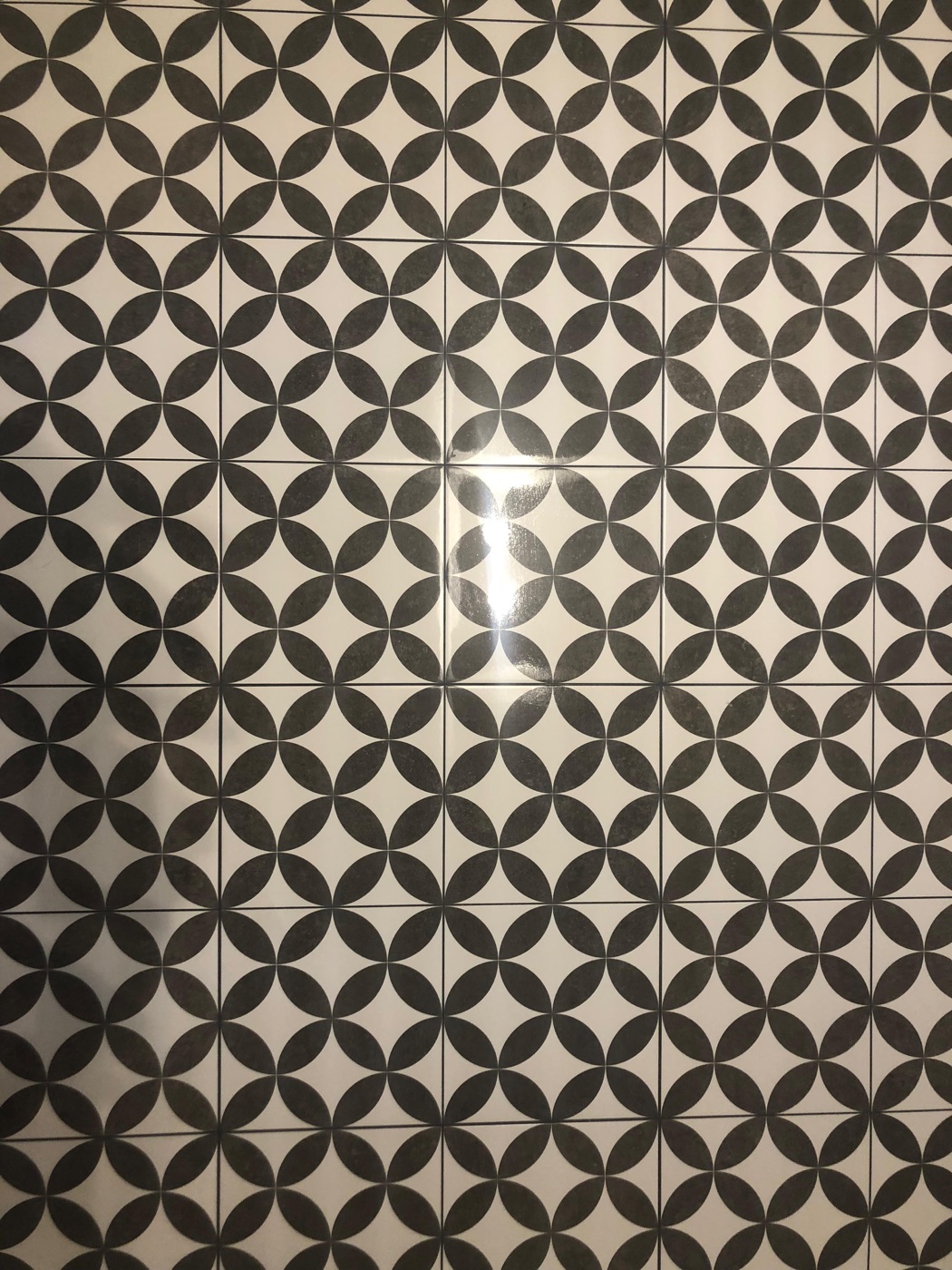 Black and white circle pattern, period hallway, Dartford. Pattern work like this is significantly more demanding than straight lay — the centring, the edge balance, the cuts at the perimeter all require careful planning. The result, in the right room, is unmatched. Pattern tiling service
Straight lay
The simplest pattern. Tiles installed in straight rows with the joints aligned in a grid.
Visual effect: Modern, clean, neutral. The tile is the focus, not the pattern. Suits contemporary interiors and minimalist design.
Best for: Bathrooms with large format tiles where you want the surface to read as continuous. Modern open-plan kitchens. Any space where the design intent is “let the material speak”.
Cost: Cheapest pattern to install. Lowest labour, lowest material wastage (typically 10%).
Common mistake: Using small tiles in straight lay creates an obvious grid that reads as institutional. Straight lay works best with large format tiles where the grid lines are minimised.
Brick bond (50% offset)
The most common pattern for rectangular tiles. Each row is offset by 50% from the row above.
Visual effect: Familiar, traditional, balanced. Less rigid than straight lay because of the offset. Reads as more characterful without being overtly designed.
Best for: Subway-style metro tiles on walls. Plank-format wood effect tiles on floors. Any rectangular tile where you want a softer alternative to straight lay.
Cost: Same as straight lay. No additional labour or wastage.
Common mistake: Using brick bond with very large format tiles can create visible “stepping” between rows where slight tile-to-tile dimension variation accumulates. Less of an issue with rectified tiles.
Third bond (33% offset)
Each row offset by one third rather than one half.
Visual effect: A more sophisticated, slightly less symmetric brick bond. Creates a more interesting visual rhythm than 50% offset.
Best for: Long plank tiles where the 50% offset creates obvious vertical lines through every other row. Third bond breaks up the verticals.
Cost: Same as standard brick bond.
Where it goes wrong: Looks awkward with square tiles. Use only with rectangular formats.
Stack bond
Tiles aligned in straight rows AND straight columns. No offset. Creates a grid pattern.
Visual effect: Very contemporary, very minimal. Reads as modern and architectural. Strong visual rhythm.
Best for: Premium contemporary bathrooms with large format rectified tiles. Architectural kitchen splashbacks. Spaces where the design intent is precise and geometric.
Cost: Same as straight lay, but requires very precise installation. Any inconsistency in tile alignment is immediately visible because the columns must be perfectly straight. Demands a flat substrate and skilled installation.
Common mistake: Stack bond with non-rectified tiles or imprecise installation looks amateur. The pattern only works if executed perfectly.
45-degree diagonal
Tiles installed at 45 degrees to the walls. Creates a rotated grid.
Visual effect: Creates a sense of movement and visual interest. Was very popular in the 1990s and 2000s. Now reads as slightly dated unless used in specific contexts.
Best for: Square tiles in classical-style interiors. Period restoration where 45-degree diagonal was historically common.
Cost: 15-20% more in labour than straight lay because of the angled cuts at every perimeter. Wastage is higher (typically 15%).
Common mistake: Diagonal lay in modern or contemporary interiors looks dated. Best avoided in current projects unless there is a specific reason.
Herringbone
Rectangular tiles laid at right angles to each other in a staggered V pattern.
Visual effect: Striking, characterful, immediately recognisable as deliberate design. Adds movement and rhythm without being chaotic. Reads as premium.
Best for: Hallways (particularly narrow ones, where the V pattern draws the eye forward). Kitchens. Bathrooms. Wood effect plank in herringbone is one of the most popular contemporary floor patterns.
Cost: 30-40% more in labour than straight lay because of the angled perimeter cuts and the slower laying process. Wastage is 15-20%.
Variations:
90-degree herringbone runs the V pattern parallel to the walls. Less aggressive than 45-degree. Better for narrow rooms.
45-degree herringbone runs the V pattern at a diagonal to the walls. More dramatic. Better for larger rooms where the pattern has space to read.
See: herringbone vs straight lay and herringbone bathroom tiles for more.
Chevron
Like herringbone but the tiles are pre-cut with mitred ends so the V points meet seamlessly. Creates a continuous unbroken zigzag.
Visual effect: Sharper and more refined than herringbone because the V points are unbroken. Reads as the most premium of the angular patterns.
Best for: High-specification renovations where the budget supports the higher labour and material cost. Larger rooms where the chevron pattern has space to read.
Cost: 40-50% more in labour than straight lay. Tiles must be specially cut (usually pre-mitred), which adds material cost. Wastage is comparable to herringbone.
Common confusion: People often confuse chevron and herringbone. Herringbone tiles are rectangles meeting at right angles. Chevron tiles are mitred to meet at a continuous point. Look closely at the V shapes — if you can see a small horizontal line at the V, it is herringbone; if the V is unbroken, it is chevron.
Basketweave
Pairs of rectangular tiles alternating direction to create a woven pattern.
Visual effect: Distinctive, traditional, period-appropriate. Common in Victorian and Edwardian properties. Adds significant character.
Best for: Period restoration. Hallways and bathrooms in pre-war properties. Contemporary properties where a traditional pattern feature is wanted.
Cost: 25-30% more in labour than straight lay. Lower wastage than herringbone because the pattern uses standard rectangular tiles without angled cuts.
Victorian geometric
Multi-piece patterns assembled from individual triangle, square, and shaped tiles to create complex geometric designs.
Visual effect: Unmatched character. Reads as authentic Victorian or Edwardian period detail. Strong focal point.
Best for: Hallways in period properties. Restoration projects where the original tiled floor needs replacing or where one is being added for the first time. Conservatories and porches.
Cost: 80-100%+ more in labour than straight lay. Requires extensive planning, precise piece-by-piece laying, careful colour matching across the batch. Wastage is 20-25%.
See: Our geometric star hallway case study for an example.
Random ashlar (modular pattern)
Multiple tile sizes laid in a calculated random pattern. Common with stone-effect tiles.
Visual effect: Natural, organic, characterful. Mimics the appearance of stone flooring laid by hand. Less obviously patterned than herringbone or chevron.
Best for: Stone effect porcelain on large floors. Country kitchens. Bathrooms with a rustic or natural design direction.
Cost: 15-25% more in labour than straight lay because of the planning required to make the “random” pattern read correctly. Wastage is moderate.
Which pattern is right for your floor?
Pattern depends on the room as much as the design preference.
- Narrow hallway: 90-degree herringbone or straight lay parallel to the walking direction.
- Large square hallway: 45-degree herringbone or Victorian geometric (period property).
- Open-plan kitchen: Straight lay in large format for contemporary; herringbone for character.
- Bathroom: Straight lay or brick bond in medium format. Save herringbone for the shower wall.
- Compact en-suite: Straight lay only. Pattern in a tight space creates visual chaos.
For pattern recommendations specific to your floor, get in touch for a free site visit. I will assess the room proportions, your design direction, and the practical considerations before recommending an approach.
See also: herringbone vs straight lay | tile installation guide | tiling cost 2026
Got a specific question? Call me on 07990 521717 , see the pattern tiling service, or use the contact form — I'm happy to give advice with no obligation.