Can You Tile Over Existing Tiles? When It Works, When It Doesn't, and What to Check
The honest answer on tiling over existing tiles in bathrooms and kitchens. When tile-on-tile works, the risks, the preparation required, and when stripping back to the substrate is the only safe option.
This is one of the most common questions I get asked on site visits. The client has a bathroom or kitchen with existing tiles they don’t like, and they want to know whether I can just tile over the top. It would save the mess and time of stripping, and it would be cheaper.
The answer is not a simple yes or no. It depends on the condition of the existing tiles, the substrate behind them, where they are in the room, and what’s going on top. I’ll walk through each factor.
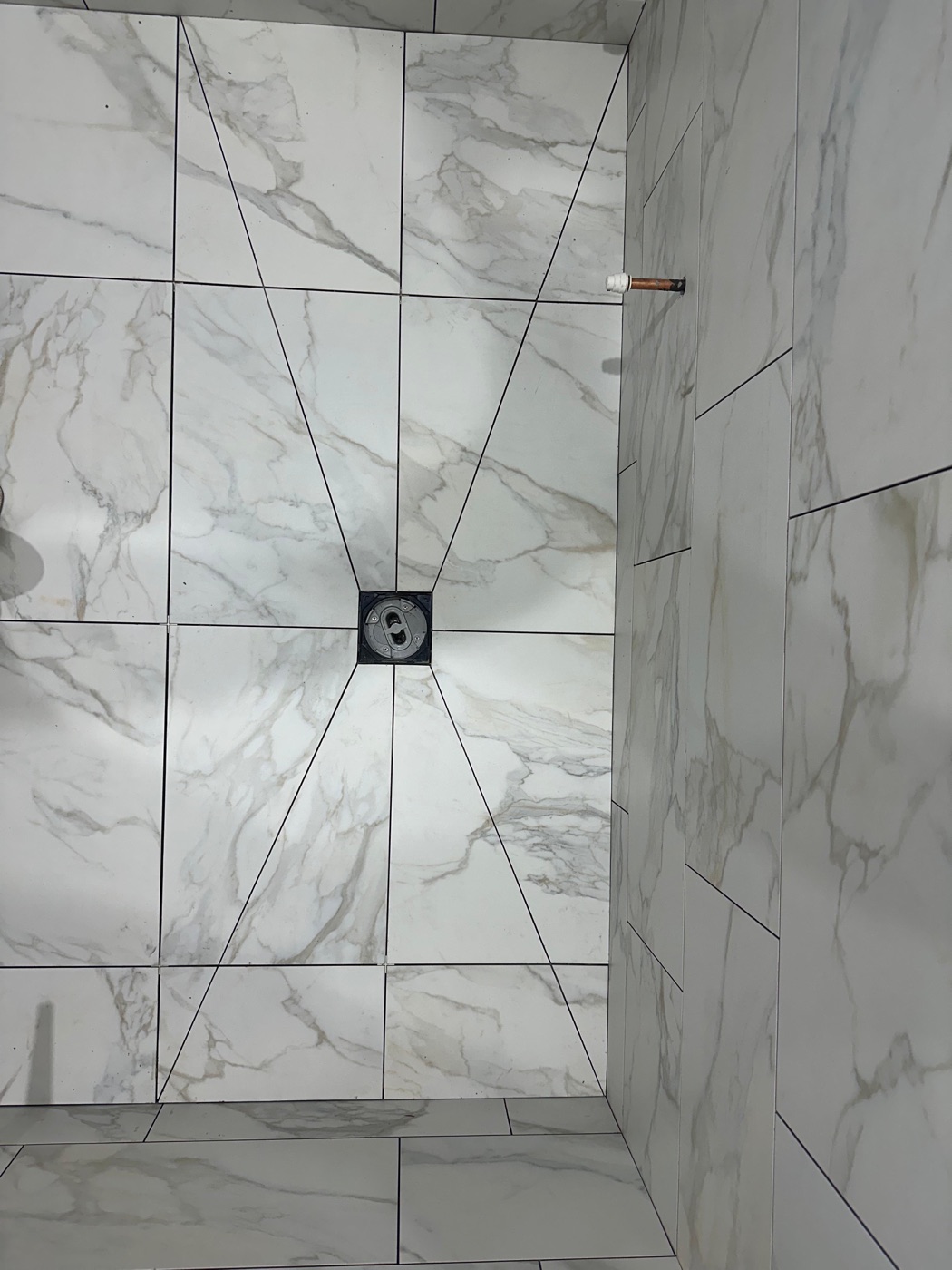 Calacatta marble wet room, Beckenham. A wet room like this requires full tanking directly onto the substrate. Tiling over existing tiles in a wet room is never appropriate. The waterproofing must be continuous, uninterrupted, and bonded to a sound substrate. Wet room service
When tile-on-tile works
The conditions need to be right. All of them.
The existing tiles must be fully bonded. Tap every tile with your knuckle. A solid sound means the tile is bonded to the substrate. A hollow sound means the adhesive behind has failed and the tile is hanging by the grout alone. If any tiles are hollow, tiling over creates a double layer with a failing bond underneath. Eventually, the whole lot comes away.
The wall must be able to take the weight. Two layers of tile plus two layers of adhesive is a significant load. On a solid masonry wall with a cement render, this is rarely a problem. On plasterboard — which is what most modern bathroom walls are — the additional weight can exceed the board’s capacity, particularly on upper portions of the wall where the board is only held by screws at the studs.
The surface must be properly prepared. The glaze on the existing tile is designed to repel water and dirt. It repels adhesive too. The surface needs mechanical abrasion — sanding, grinding, or scarifying — to create a key for the adhesive to grip. A bonding primer should be applied after abrasion. Even then, the bond strength to a glazed surface is lower than to a raw substrate. It works. It’s not as strong.
The room must not be a wet area that needs tanking. This is the deal-breaker for many bathroom jobs. If the existing tiles are in a shower enclosure or anywhere that requires waterproofing, you cannot tile over. The tanking membrane must go directly onto the substrate, bonded to it with full coverage. Tanking over old tiles is unreliable because the membrane is bonded to a glazed surface rather than a porous one. If the tanking fails — even in one spot — water gets behind both layers of tile and the damage is catastrophic.
Where it commonly works
Kitchen splashbacks. A strip of wall between worktop and wall units, in a non-wet area, on a solid wall. The existing tiles are usually well-bonded, the area is small, and the weight addition is modest. This is the most reliably successful tile-on-tile application.
Dry bathroom walls. The wall opposite the shower, the wall above the basin, a half-height tile in a cloakroom. These areas don’t get sustained wet conditions and the weight is typically within limits.
Floor tiles on a concrete slab. A concrete floor can support the additional weight of a second tile layer easily. The preparation is the same — abrade, prime, use the right adhesive — but the substrate capacity is rarely a concern. Height at thresholds and under doors needs checking.
Where it doesn’t work
Shower enclosures. The walls need tanking. Tiling over existing tiles in a shower without addressing the waterproofing means no tanking behind the new tiles. Water will get through the grout over time and find whatever is behind the old tiles. If the original tiler tanked properly, fine. If they didn’t — and in many older bathrooms they didn’t — you’re sealing moisture into the wall.
Wet rooms. Non-negotiable. A wet room must be tanked floor and walls, directly to the substrate. There is no scenario where tile-on-tile is appropriate in a wet room.
Old plasterboard. If the existing tiles are on plasterboard and the bathroom has been in use for ten or fifteen years, the plasterboard behind the tiles may have absorbed moisture, particularly around the shower and bath. It may look fine from the front. When I strip old tiles from plasterboard, I regularly find boards that are soft, swollen, or mouldy behind. Tiling over this puts new tile on a substrate that is failing. The correct approach is stripping the tiles, assessing the board, replacing any damaged sections, and tiling on a sound surface.
Over cracked or uneven existing tiles. Cracks in existing tiles usually indicate movement or adhesive failure in the substrate. Tiling over a cracked tile is covering a symptom. The cause — substrate movement, inadequate adhesive, missing expansion joints — is still present and will affect the new tile layer.
The thickness question
Every tile layer adds depth. A typical build-up:
- Existing adhesive: 3-6mm
- Existing tile: 8-10mm
- New adhesive: 3-6mm
- New tile: 8-10mm
Total addition: 15-25mm beyond the original wall surface.
This creates practical issues:
- At edges: Where the tiled area ends, there’s a visible step that needs trim or a finishing detail.
- At fixtures: Taps, shower valves, toilet flush plates, light switches, and towel rails are all set at a specific depth. Adding 20mm moves the wall forward relative to these fixtures. Shower valves in particular can be problematic because the valve body is set within the wall and the handle protrusion is calibrated for the original wall depth.
- At doors and windows: The reveal depth changes. Door frames that sit flush with the original tile are now recessed behind the new tile.
None of these problems are unsolvable. But each one adds complexity, time, and cost that erodes the supposed saving of not stripping.
The honest calculation
Stripping existing tiles costs money — in labour time and disposal. A standard bathroom strip takes half a day to a full day, depending on how well the tiles were originally bonded and whether the substrate needs repair.
Tile-on-tile preparation also costs money — abrasion, priming, the right adhesive, trim at edges, adjustments around fixtures.
The actual cost difference is often smaller than clients expect. And the result of starting from a clean substrate is more reliable, the waterproofing can be done properly, and any hidden problems (damp plasterboard, failed adhesive, movement cracks) are discovered and fixed rather than buried.
My general recommendation: if the budget allows, strip back to the substrate. If you’re tiling over for practical reasons (timeline, dust, cost), make sure the conditions above are met and accept that the bond is adequate rather than optimal.
Get in touch for a site assessment. I’ll tap the existing tiles, check the wall condition, and give you a straight answer on whether tile-on-tile is viable or whether stripping is the better investment. Related: why tiles crack | tile installation guide | what is tanking
Got a specific question? Call me on 07990 521717 , see the bathroom tiling service, or use the contact form — I'm happy to give advice with no obligation.