Best Tile Adhesive: A Tiler's Guide to What to Use Where
The right tile adhesive for every situation in a UK home. C1, C2, S1, S2 explained, and the products that actually work in domestic installations.
Tile adhesive is the most important component of a tiling job that nobody pays attention to. The tiles get the credit when the bathroom looks beautiful. The grout gets the criticism when something looks wrong. The adhesive is what determines whether the tile actually stays on the wall five years from now.
Most of the failures I am called to fix are adhesive failures. Wrong product specification, inadequate coverage, or installation in conditions the product was not rated for. This guide explains what the adhesive ratings mean and what to use where.
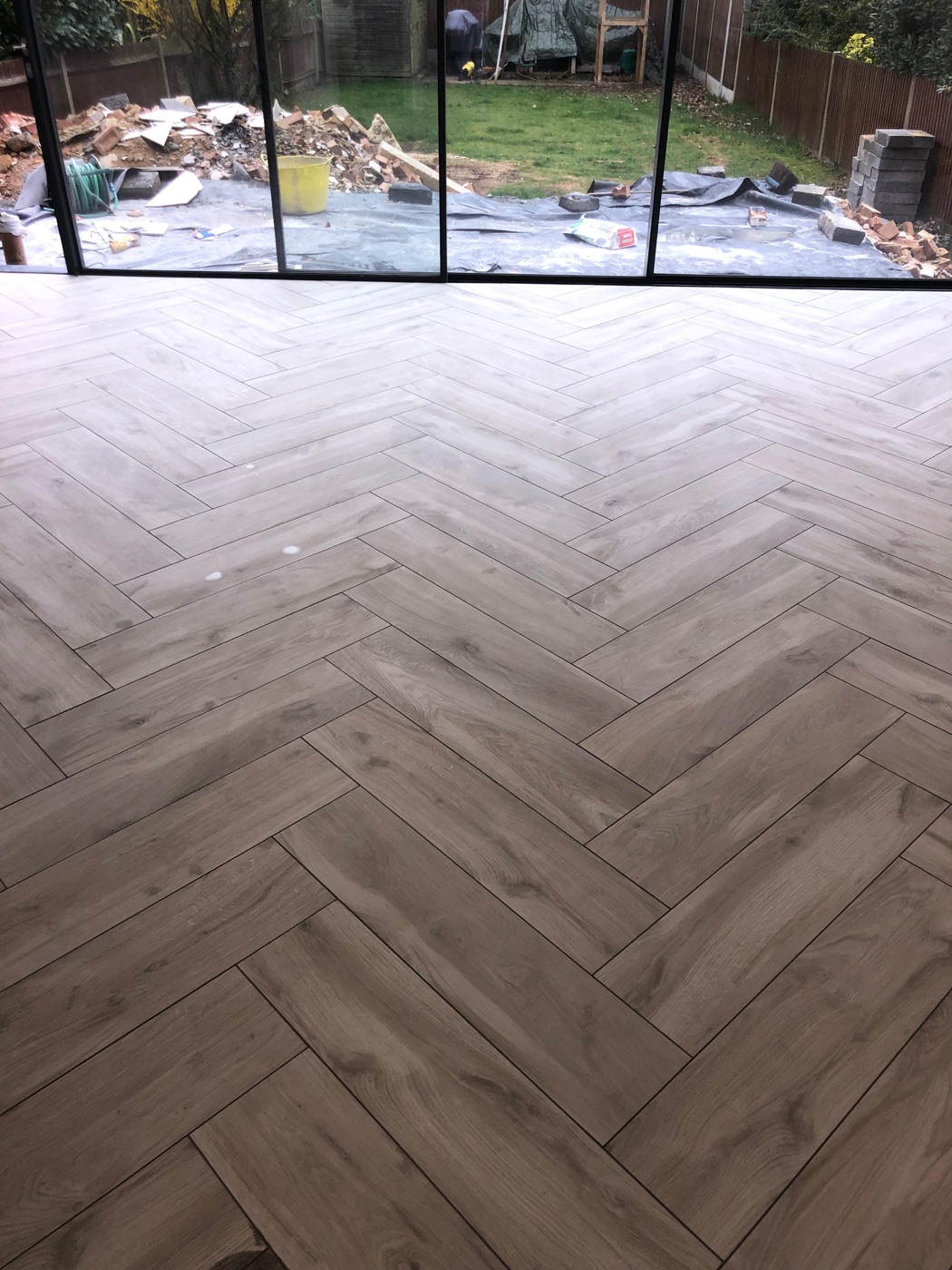 Grey herringbone kitchen floor over underfloor heating, Orpington. Tiles over UFH on a timber subfloor require flexible C2S1 or C2S2 adhesive specifically rated for thermal cycling. The wrong adhesive cracks within a year. Kitchen floor tiling service
The classification system
UK tile adhesives are classified under the European standard EN 12004. The classification appears on the product packaging as a code like “C2TE S1” or “R2T”. Understanding the codes lets you check that the product matches the application.
First letter: type
C = Cement-based adhesive. The most common type. Mixed with water on site. Available as one-part or two-part.
D = Dispersion adhesive. Pre-mixed paste, ready to use. Used for ceramic wall tiles in dry areas. Less common for floors.
R = Reaction resin adhesive (typically epoxy). Two-part products mixed on site. Used for chemical resistance, specialist applications, and some natural stone work. More expensive and harder to work with than cement-based.
First number: bond strength
C1 = Standard bond strength (≥0.5 N/mm²). Adequate for ceramic wall tiles in dry conditions on stable substrates.
C2 = Improved bond strength (≥1.0 N/mm²). Required for porcelain, large format tiles, wet areas, and any demanding application.
Letter codes: additional properties
T = Thixotropic (slip resistant). Tiles do not slide down the wall after application. Important for wall installations and large format tiles.
E = Extended open time. The adhesive stays workable longer after application, giving the tiler more time to position tiles. Useful for complex layouts.
F = Fast setting. Sets in 2-6 hours instead of 24. Used when the floor needs to be walked on quickly. Often used for repair work.
Deformability codes
S1 = Deformable. Can absorb some substrate movement. Required for timber floors, underfloor heating, and most domestic floor installations.
S2 = Highly deformable. Higher movement absorption. Used for very flexible substrates or specialist applications.
A C2TE S1 adhesive is therefore: cement-based, improved bond strength, thixotropic, extended open time, deformable. This is the typical specification for porcelain on a timber floor.
What to use where
Ceramic wall tiles in a dry room (e.g., kitchen splashback)
Specification: C1T (standard, slip resistant) or D2T (improved dispersion)
Examples: BAL Wall and Floor Tile Adhesive, Mapei Adesilex P9.
Why: Ceramic is porous and bonds easily. Dry conditions mean no flexibility requirement. Standard adhesive is adequate.
Ceramic wall tiles in a wet area (e.g., shower wall)
Specification: C2T or C2TE
Examples: BAL Single Part Flexible, Mapei Kerabond T plus Isolastic.
Why: Wet conditions demand a stronger bond and a flexible product that handles thermal cycling. Standard adhesive will fail at the bond when subjected to constant moisture and temperature variation.
Porcelain wall tiles
Specification: C2T or C2TE
Examples: BAL Single Part Flexible, Mapei Adesilex P10 plus Isolastic.
Why: Porcelain is non-porous and difficult for adhesive to grip. C2 grade has the bond strength to attach reliably. C1 adhesive on porcelain is a guaranteed failure.
Porcelain floor tiles on concrete
Specification: C2 or C2TE
Examples: BAL Single Part Flexible, Mapei Keraflex.
Why: Concrete is stable so flexibility is less critical. C2 bond strength is essential for porcelain.
Porcelain floor tiles on timber subfloor
Specification: C2 S1 or C2 S2
Examples: Mapei Keraflex Maxi S1, BAL Stone and Tile PTB.
Why: Timber moves seasonally. Without flexibility (S1 or higher), the tiles will crack as the substrate flexes. The S rating is essential, not optional. Decoupling membrane should also be used. See why tiles crack.
Large format tiles (600mm+)
Specification: C2 S1 or higher, applied with full coverage technique
Examples: Mapei Keraflex Maxi S1, BAL Stone and Tile PTB.
Why: Large tiles bear concentrated loads and require a continuous bond beneath the tile. Full coverage means back-buttering (applying adhesive to both the substrate and the back of the tile) to achieve 95%+ bond area.
Tiles over underfloor heating
Specification: C2 S1 or S2, rated for underfloor heating use
Examples: Mapei Keraflex Maxi S1, BAL Single Part Fastflex.
Why: Thermal cycling causes constant expansion and contraction. The adhesive must remain flexible across thousands of heating cycles. Standard C2 (without S rating) goes brittle and cracks. Always check that the product is specifically rated for UFH use. See tiling over underfloor heating.
Natural stone (marble, limestone, travertine)
Specification: C2 grey adhesive (white adhesive can stain stone), often S1
Examples: Mapei Kerabond T plus Isolastic, BAL Stone and Tile.
Why: White adhesive contains compounds that can migrate through porous natural stone and cause discolouration on the visible face. Grey adhesive avoids this. C2 bond strength is essential for the heavier stone tiles. See marble in the bathroom.
Mosaic tiles
Specification: C2 white (for clean grout joints) or grey for darker mosaic
Examples: Mapei Adesilex P10, BAL Easypoxy AG.
Why: Mosaic has many small grout joints where adhesive could be visible. White adhesive is preferred to avoid darkening the joint. C2 bond strength because mosaic sheets need reliable adhesion across all the small pieces.
Wet rooms (full installation)
Specification: C2 S1 minimum, applied over a tanking membrane
Examples: Mapei Keraflex Maxi S1 (after tanking with Mapelastic), BAL Single Part Flexible (after tanking with BAL Tank-it).
Why: Wet rooms combine the demands of constant moisture, thermal cycling from hot showers, and substrate movement. The full system (tanking + flexible adhesive + correct grout) is what makes a wet room last. Skipping any element compromises the whole.
Common adhesive mistakes
Using one universal adhesive for everything. A single adhesive cannot meet every situation. The best tilers carry multiple products and specify the right one for each job.
Mixing adhesive too thin. Most cement adhesives have a specific water ratio. Adding extra water makes the adhesive easier to spread but reduces bond strength significantly.
Not back-buttering large tiles. Without back-buttering, large tiles have voids in the adhesive bed where the tile bridges low spots in the substrate. These voids become weak points where the tile cracks under load.
Tiling before the adhesive is workable. Cement adhesive needs 5-10 minutes to slake (chemically activate) after mixing. Tiling immediately after mixing reduces bond strength.
Letting the adhesive skin over before tiling. Once adhesive skins over (forms a film on the surface), the bond is compromised. Cover and re-comb if necessary.
Wrong notched trowel size. Different tile sizes need different notch sizes. Too small a notch leaves insufficient adhesive. Too large wastes product and creates squeeze-out at joints. The product datasheet specifies the right notch size.
How to verify what your tiler is using
Ask the tiler to name the specific product before work starts. A competent tiler will tell you immediately, and the product should match the application. If you have any doubt, ask to see the bag during installation or check the empty bag in the skip after.
The product datasheet is publicly available online from manufacturers. You can verify that the product is rated for your application (porcelain, large format, wet area, underfloor heating, timber substrate, etc).
For tiling work in Bromley and South East London where every adhesive is correctly specified for its application, get in touch. I name the products in my quote and explain why they are appropriate for your specific job.
See also: why tiles crack | tile installation guide | tiling over underfloor heating
Got a specific question? Call me on 07990 521717 , see the porcelain tiling service, or use the contact form — I'm happy to give advice with no obligation.