Bathroom Tiles: The Complete Guide to Materials, Styles and Getting It Right
Everything you need to know about bathroom tiles: materials, formats, patterns, waterproofing, costs and common mistakes. A practical guide from a tiler with 44 years experience.
Choosing bathroom tiles is one of those decisions that feels straightforward until you start researching it. There are dozens of materials, hundreds of formats, pattern options, colour directions, and technical requirements that change depending on where the tile is going and what the substrate underneath it is.
This guide covers everything you need to make the right choice for your bathroom: materials, formats, what works where, waterproofing, costs, and the mistakes that cause problems down the line. It is written from 44 years of professional tiling experience across Bromley and South East London.
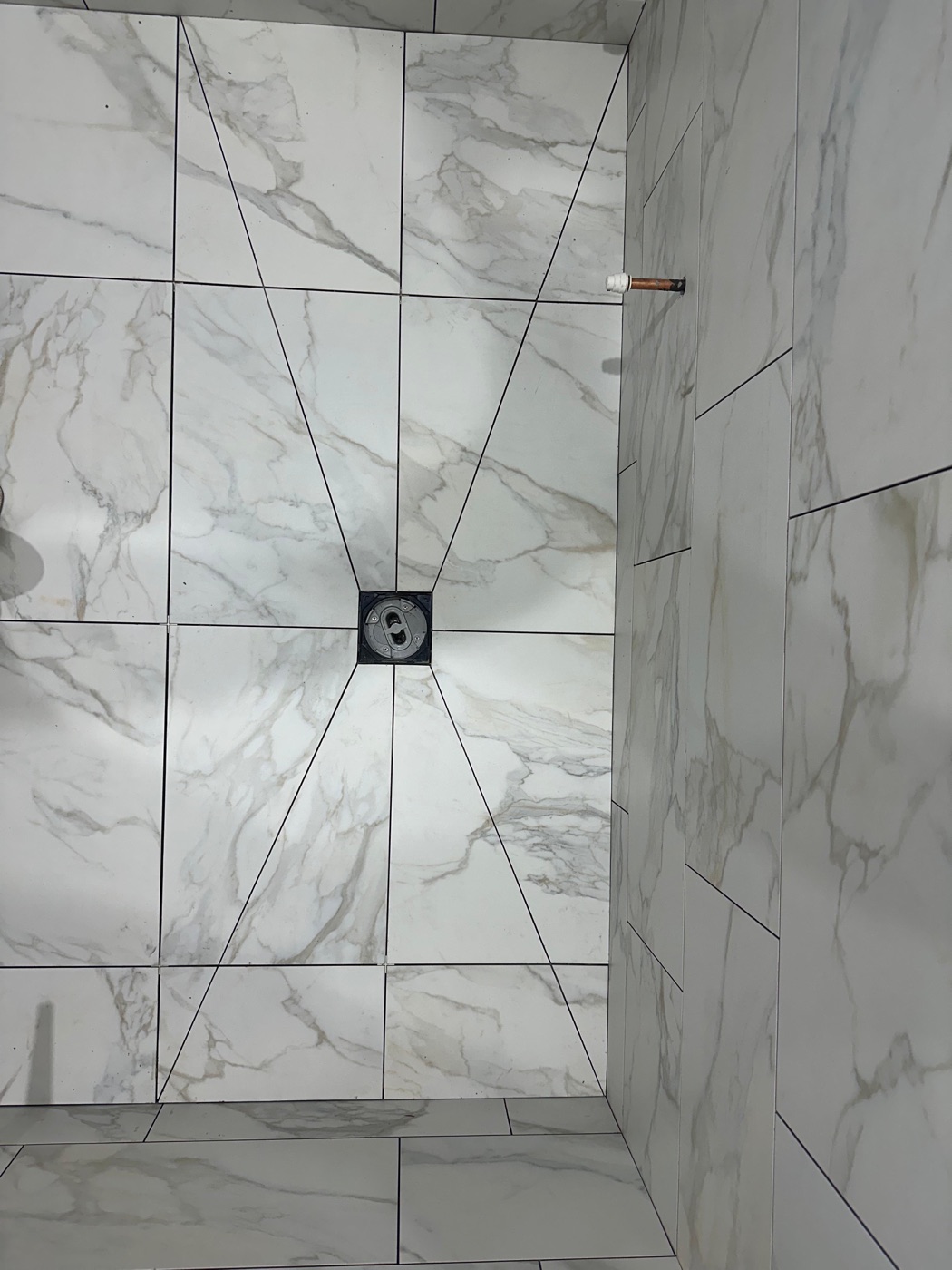 Calacatta marble wet room, Beckenham — full floor and wall tile in natural marble, with a graded floor draining to a linear channel. Material choice, format, pattern, waterproofing, and installation all working together correctly. Wet room service
Part 1: Tile materials for bathrooms
Porcelain
Porcelain is the most practical bathroom tile. It is non-porous, which means water and moisture do not penetrate the surface. It handles temperature and humidity variation well. It is harder than ceramic and more resistant to chips and scratches. It comes in virtually every format and style, including convincing stone and marble effects.
Most of the tile trends of recent years, including large format tiles, textured surfaces, and matte finishes, are primarily delivered in porcelain. For a busy bathroom that needs to last and stay looking good, porcelain is the reliable choice.
Best for: Floors, shower walls, full bathroom tiles, high-traffic family bathrooms.
Ceramic
Ceramic is softer than porcelain and slightly more porous. It is easier to cut, which makes it more practical for complex shapes, and it costs less. In a bathroom that is not a wet room, ceramic wall tiles are perfectly serviceable. For floor tiles and shower areas, porcelain is the better specification.
Best for: Feature walls, splashbacks, lower-traffic bathrooms. Less suitable for floors or full shower enclosures.
Natural stone and marble
Marble and natural stone (travertine, slate, limestone, quartzite) are porous materials that require a different installation process to porcelain and ceramic. They need specific adhesives, sealing before and after grouting, and movement joints at perimeters and changes of plane.
When installed correctly, natural stone is exceptional. A marble bathroom, laid properly, is a different class of finish to porcelain. When installed incorrectly, the problems are permanent: staining from grout haze that absorbs into the stone, cracking from thermal movement without proper joints, or debonding from the wrong adhesive.
Full detail on natural stone: marble in the bathroom: what every homeowner should know.
Best for: Luxury bathrooms, wet rooms, feature walls. Requires specialist installation.
Zellige and handmade tiles
Zellige is a Moroccan handmade clay tile with irregular surface and glaze variation. It adds character and life to a bathroom in a way that factory tiles do not. The variable thickness requires individual bed adjustment during laying, which takes longer than standard tile.
For more: zellige tiles: everything you need to know.
Best for: Feature walls, shower feature panels, smaller bathrooms where the handmade quality reads up close.
Mosaic
Mosaic tiles are small tiles, typically supplied on mesh sheets, used in shower areas, as borders, and on floors where the small format aids drainage slope. They require precise alignment and careful grouting. The large number of grout lines means more maintenance. In 2026, herringbone mosaic brick on shower floors is particularly popular.
Best for: Shower floors, feature inserts, decorative borders.
Part 2: Formats and sizes
The format of the tile affects how a room reads.
Large format (600x600 and above, including 1200x600 and 1200x1200): Fewer grout lines, cleaner look, makes a room feel larger. Requires a flatter substrate and more precise installation. Very large format tiles (over 900mm) need specific handling equipment.
Standard wall format (300x600, 300x450): The workhorse of bathroom tiling. Practical, versatile, available in every style.
Metro and brick format (75x150 to 100x300): Suited to herringbone, straight lay, vertical stack. Currently very popular in warm tones and handmade effects.
Square formats (100x100, 200x200): Less used now than previously. Can suit period-style bathrooms.
Mosaic (anything up to 50x50 per tile, supplied on mesh): Shower floors, borders, feature areas.
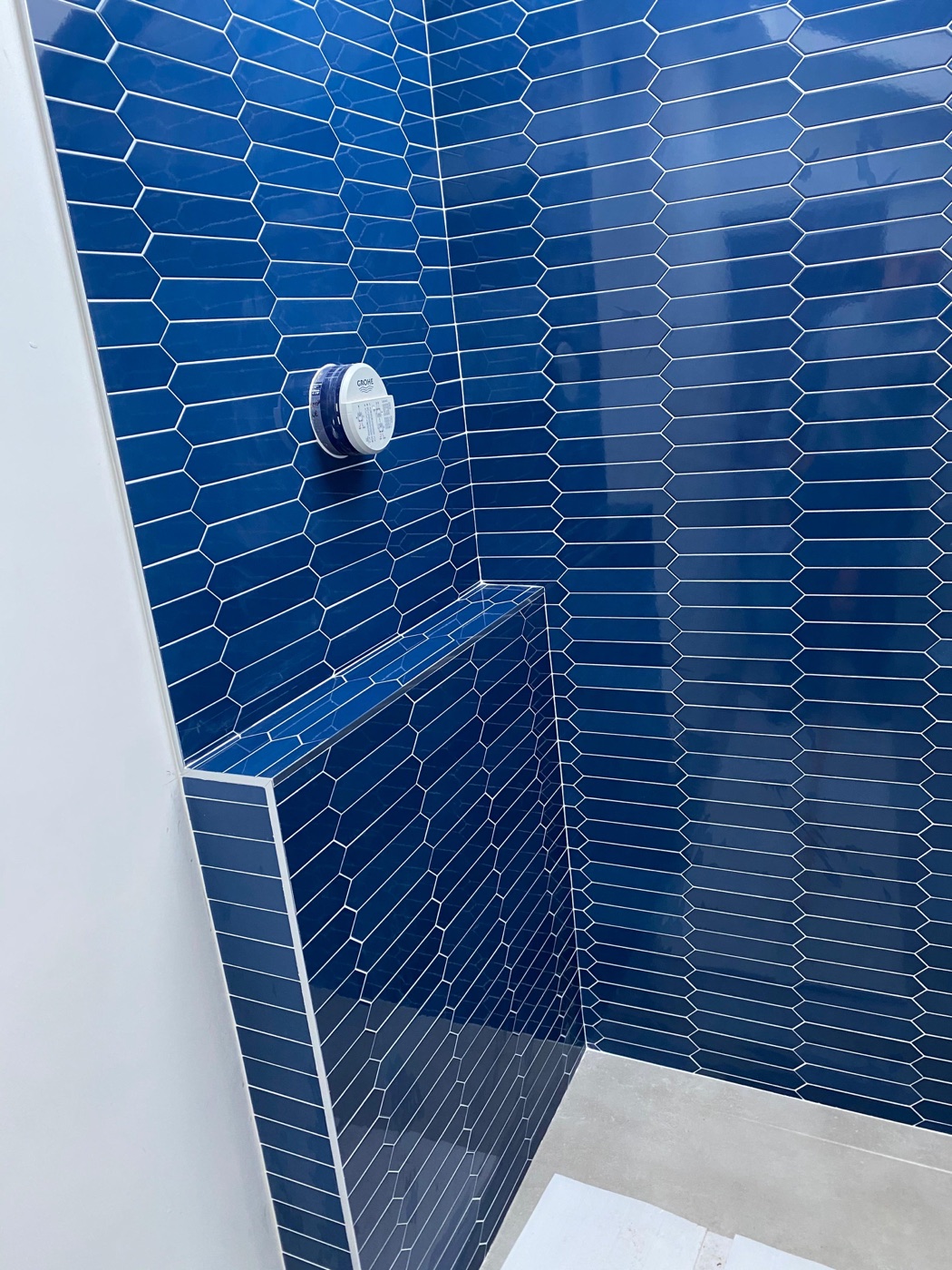 Navy hexagon mosaic bathroom with built-in tiled bench, Beckenham — mosaic format, bold colour, full bathroom re-tile including the bench seat. Format, colour, and pattern all chosen deliberately. Bathroom tiling service
Part 3: Patterns
Straight lay: The default. Tiles set parallel to the walls. Joints run in straight lines. Can be offset (brick bond) by a third or half to break up the joint alignment.
Herringbone: The most requested pattern right now. Rectangular tiles in a V-pattern. At 45 degrees it is traditional and dramatic; at 90 degrees it is contemporary and slightly quieter. Costs 20-35% more in labour than straight lay. Read more: herringbone bathroom tiles.
Diagonal: Square or rectangular tiles set at 45 degrees to the walls. Suits period properties and makes a room feel larger.
Tile drenching: Running the same tile across floor and walls. Coherent, architectural, increasingly popular in wet rooms. Read more: tile drenching explained.
Complex geometric: Victorian star patterns, 3D cube illusions, encaustic multi-piece designs. Technically demanding. Requires careful setting-out from the centre before a single tile is laid.
Part 4: Waterproofing
Waterproofing in a bathroom is not optional. In a wet room it is a non-negotiable structural element. In a standard bathroom shower enclosure, a tanking membrane behind the tiles is the correct specification.
Many older bathroom installations have no waterproofing at all. The tile was laid directly onto plasterboard or plaster and the grout was expected to keep moisture out. It does not. Grout is not waterproof. Water eventually gets behind tiles, into the wall structure, and causes damage that is expensive to fix.
The correct sequence: prepare substrate, apply tanking membrane (minimum two coats with tape at joints and changes of plane), allow to cure, then tile.
Read more: what is tanking and why does it matter?
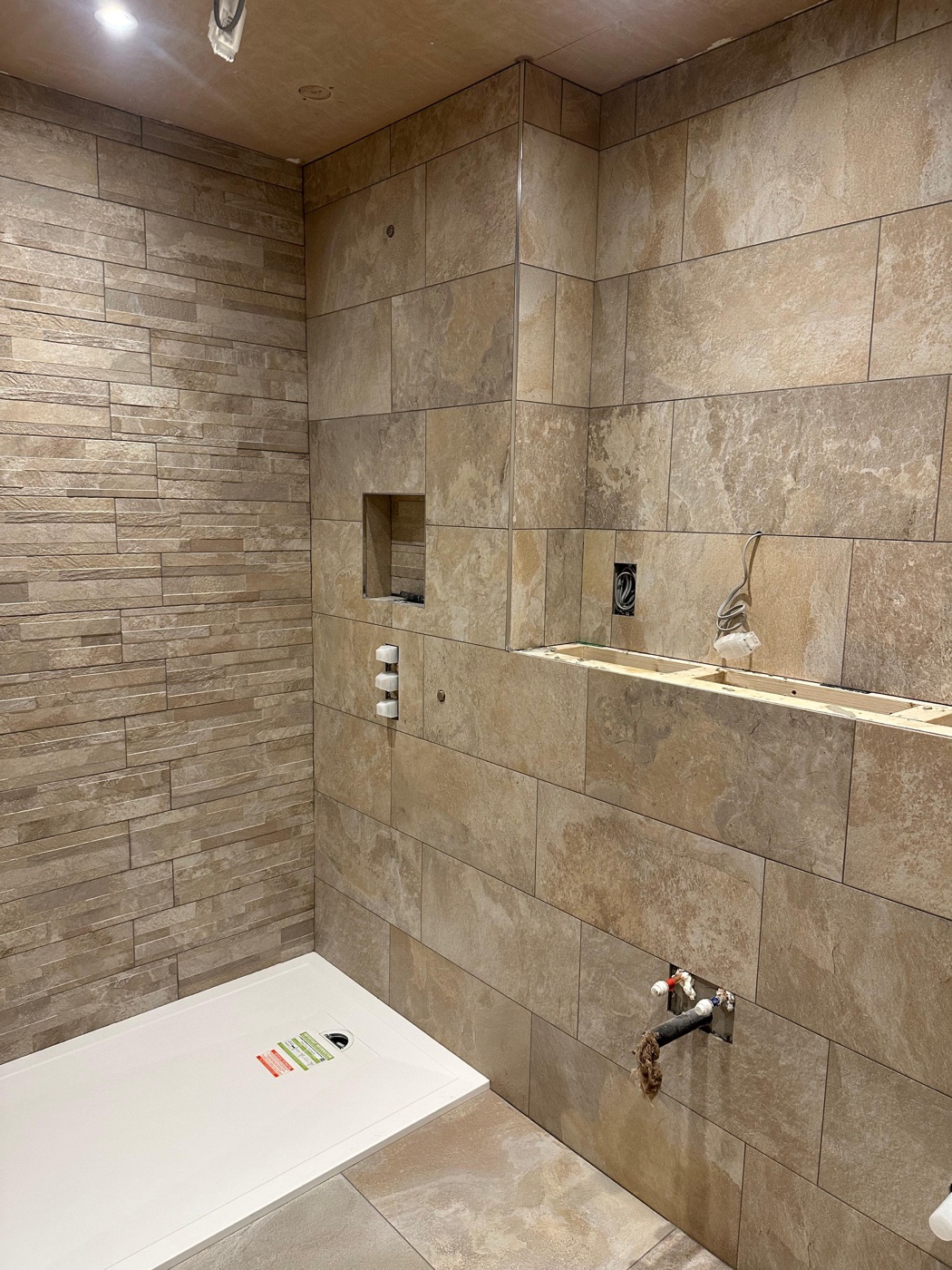 Stone porcelain shower enclosure with twin niches and chrome trim, West Wickham — a practical demonstration of what correct installation looks like: level tiles, aligned grout, silicone at all plane changes, recessed niches cut cleanly. Bathroom tiling service
Part 5: Common mistakes and how to avoid them
Grouting instead of siliconing at changes of plane. The joint between the floor and the wall, between the bath and the wall, between the shower tray and the wall: these must be siliconed, not grouted. Grout is rigid. These joints move. Grout will crack. Water gets in. The correct material is sanitary silicone that moves with the joint. This is one of the most common failures I see in bathrooms that were not done properly.
Wrong adhesive for the tile. Marble and natural stone need a grey flexible adhesive. White adhesive can stain porous stone. Standard flexible adhesive for porcelain. C2S1 or higher for floors with underfloor heating. The adhesive specification is not optional.
Substrate not prepared. A tile is only as good as what is behind it. A substrate that flexes, is uneven, or is not sound will crack tile or cause debonding. Prep is not visible when the job is done, so it is easy to skip. It is also the thing that fails first when it is skipped.
Grout lines inconsistent. Grout line width should be chosen before the job starts and maintained throughout. In herringbone, this requires constant checking. Inconsistent grout lines on a finished bathroom look wrong.
Read more: how to spot good tiling
Part 6: Cost overview
Bathroom tiling costs in South East London in 2026 vary by room size, tile type, pattern, and substrate condition. For a realistic breakdown see how much does tiling cost in 2026?
The key principle: cheap tiling is always cheap for a reason. The reasons are usually in substrate prep, adhesive specification, or movement joint treatment. These are the things that fail.
Getting advice
I offer free, no-obligation quotes across Bromley, Beckenham, Orpington, Chislehurst, and surrounding areas. I am happy to discuss tile choices, materials, and what will work in your specific bathroom before any work begins.
Contact me for a free quote or call 07990 521717.
FAQ
What is the best tile for a bathroom floor? Porcelain is the most practical: non-porous, durable, slip-resistant in the right finish. Choose a matte or satin finish for grip in a wet environment.
Do I need waterproofing behind bathroom tiles? In a shower enclosure, yes. In a full wet room, yes. In the rest of a bathroom, it is best practice and significantly extends the life of the installation.
How much does a bathroom re-tile cost? It depends on the room, the tile, the substrate, and the pattern. A site visit is the only way to give an accurate price. See bathroom tiling costs explained.
What is the most popular bathroom tile style in 2026? Warm tones, textured surfaces, zellige and handmade-look tiles, large format stone effects, and herringbone patterns. See bathroom tile trends 2026.
Related reading: Bathroom tile trends 2026 · Marble in the bathroom · Tile drenching · Herringbone bathroom tiles · Bathroom tiling service · Wet room service
Got a specific question? Call me on 07990 521717 , see the bathroom tiling service, or use the contact form — I'm happy to give advice with no obligation.