Accessible Bathroom Tiling: Level Access Showers, Slip Ratings, and Getting It Right for All Ages
How to tile an accessible bathroom that works for elderly users, wheelchair access, and future-proofing. Level access showers, grab rail backing, and slip-safe tile choices.
Accessible bathroom tiling is not a niche specialism. It is increasingly the standard expectation. Homeowners in their 40s and 50s are future-proofing bathrooms for their own later years. Parents are adapting bathrooms for elderly relatives. And families with mobility-impaired members need bathrooms that work safely for everyone.
The good news is that an accessible bathroom does not need to look clinical or institutional. The technical requirements (level access, slip resistance, reinforced walls) are invisible once the bathroom is finished. The result can look identical to any premium contemporary bathroom.
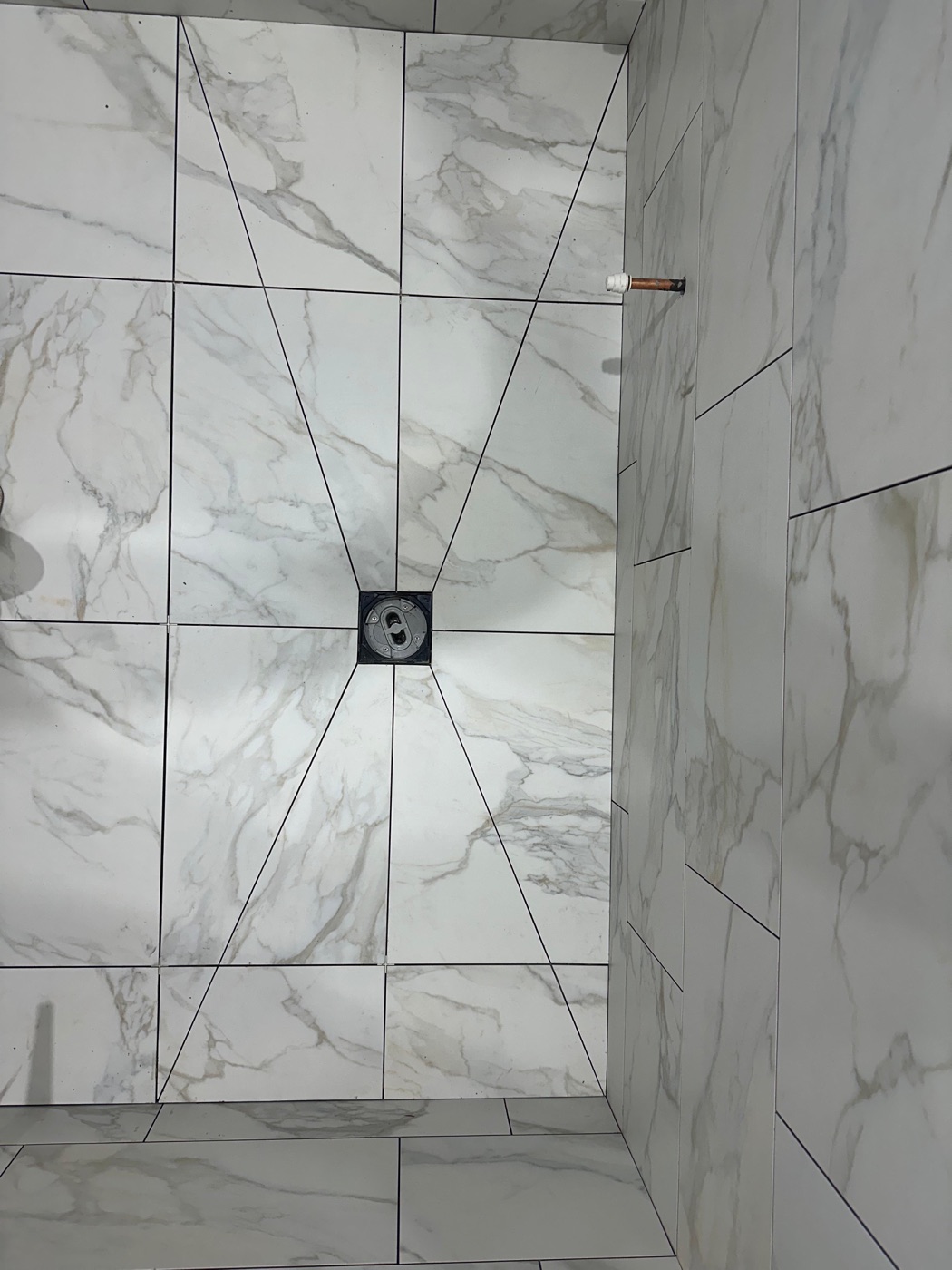 Calacatta marble wet room, Beckenham. Level access, graded floor to a linear drain, full tanking. This is an accessible bathroom that happens to also be one of the most luxurious installations I have completed. Accessibility and aesthetics are not in conflict. Wet room service
Level access showers
The single most important accessible feature in a bathroom is eliminating the step into the shower. A standard shower tray sits 50-100mm above the bathroom floor. For someone with reduced mobility, arthritis, or a wheelchair, that step is a barrier or a hazard.
How level access works
The shower floor is tiled as a continuous surface with the rest of the bathroom floor, graded to fall toward a drain. There is no tray, no lip, no step. Water drains through the tiled floor into a waste below.
This is technically a wet room approach, even if only the shower area is waterproofed. The critical elements:
Tanking. The shower zone floor and walls must be fully tanked with a waterproofing membrane. The tanking extends at least 300mm beyond the shower zone in all directions, and to full ceiling height on the shower walls.
Floor grading. The floor slopes toward the drain at approximately 1:60 (roughly 12mm per metre). This is built into the screed or pre-formed shower former beneath the tiles.
Drainage. A linear drain along one wall is preferable for accessible bathrooms because it allows the floor to slope in one direction only, which is simpler to construct and easier for wheelchair wheels to cross.
Tile choice. The shower floor tiles must be R11 rated for slip resistance. Mosaic format (small tiles on mesh sheets) works well for following the floor gradient. See shower tile ideas.
What about existing bathrooms?
Converting an existing bathroom to level access involves removing the shower tray (and potentially lowering the floor level to accommodate the gradient and drain). This is a significant intervention but achievable in most bathrooms. Concrete subfloors are simpler. Timber subfloors require more structural consideration.
See: wet room vs shower tray and wet room installation cost.
Slip resistance: the most important specification
Falls in the bathroom are a leading cause of injury in UK homes, particularly for people over 65. Tile choice directly affects fall risk.
The DIN 51130 R-value scale
- R9: Low grip. Not suitable for wet areas. Dry corridors only.
- R10: Moderate grip. Minimum for general bathroom floors away from the shower.
- R11: Good grip. Recommended for shower floors, wet rooms, and the area immediately outside the shower where wet feet step onto the dry floor.
- R12-R13: High grip. Industrial level. Not typically used in domestic settings.
Which tiles meet R11?
Matte porcelain with a textured surface typically meets R11. The texture is not rough enough to be uncomfortable underfoot but provides meaningful grip when wet.
Mosaic tiles with unglazed or matte finishes generally meet R11 because the high density of grout joints provides additional grip.
Stone with a honed or natural finish often meets R11. Polished stone does not.
Polished and gloss tiles almost never meet R10, let alone R11. They should not be used on any bathroom floor in an accessible bathroom. See matte vs gloss tiles.
Testing before committing
Ask for the slip rating before buying tiles. It should be on the product datasheet. If the supplier cannot provide it, the tile has not been tested and should not be assumed safe.
As a practical test: wet the tile surface and run your thumb across it firmly. If your thumb slides freely, the tile does not have adequate wet grip for a bathroom floor. This is not a substitute for a lab test, but it catches the obvious failures.
Grab rail backing
Grab rails need to bear a person’s full weight. A 90kg person falling and catching a grab rail applies several hundred kilograms of momentary force. Standard 12.5mm plasterboard cannot hold this. The screws will pull through and the rail will fail.
The solution
Install 18mm marine plywood or tile backer board behind the tiles in every location where a grab rail might be fitted. This should be screwed directly into the wall studs, providing a solid, permanent backing.
The key insight: install the backing before tiling, even if the grab rails are not being fitted immediately. This allows rails to be added at any point in the future without removing tiles. The backing is invisible once the tiles are on.
Where to install backing
At minimum:
- Both sides of the shower entry area
- The wall adjacent to the toilet
- The wall next to the bath (if retaining a bath)
- Inside the shower enclosure at grip height (approximately 750-900mm from the floor)
For maximum future-proofing, install backing on all bathroom walls between 600mm and 1200mm height. The cost is minimal (a few sheets of plywood) and the future flexibility is significant.
Floor continuity
In an accessible bathroom, transitions between floor levels should be eliminated wherever possible.
Within the bathroom: The floor should be one continuous surface from the door to the shower. No steps, no lips, no raised thresholds. The shower drain is the only interruption.
At the bathroom door: The threshold should be flush with the corridor or landing floor. A raised threshold that a wheelchair cannot cross defeats the purpose of an accessible bathroom. A recessed threshold strip or a ramped transition can accommodate small level changes.
Floor material continuity: Using the same tile across the full bathroom floor (including the shower zone) creates a surface that is visually continuous and practically barrier-free. Tile drenching (one tile throughout) is the strongest approach for accessible bathrooms. See tile drenching trend.
Other accessible tiling considerations
Contrasting colours at edges. For visually impaired users, a contrasting tile colour at the edge of the shower zone helps identify the wet area boundary. A dark border tile around a light shower floor, or vice versa, provides a visual cue without a physical barrier.
Large format floor tiles. Fewer grout lines means a smoother surface for wheelchair wheels and walking frames. Grout lines, particularly wide ones, can catch small wheels and create resistance.
Heated floors. Underfloor heating eliminates the need for towel radiators at low level, which can obstruct wheelchair movement. See tiling over underfloor heating.
Easy-clean surfaces. Matte porcelain with minimal grout lines is the easiest bathroom surface to maintain. For users with limited mobility, minimising cleaning effort is a practical accessibility consideration.
What an accessible bathroom looks like
The best accessible bathrooms are indistinguishable from any well-designed contemporary bathroom. The Beckenham wet room at the top of this page is fully accessible: level access, graded floor, linear drain, full tanking. It also happens to be one of the most beautiful bathrooms I have installed.
Accessibility is not about compromise. It is about building correctly from the start so the bathroom works for everyone, now and in the future.
For a free consultation on accessible bathroom tiling in Bromley or South East London, get in touch. I can advise on level access options, slip-rated tiles, and grab rail backing for your specific property.
See also: wet room vs shower tray | bathroom tiles complete guide | shower tile ideas
Got a specific question? Call me on 07990 521717 , see the wet room service, or use the contact form — I'm happy to give advice with no obligation.